Guidance, ideas and examples to support schools in developing their curriculum, pedagogy, enrichment and support for more able learners, within a whole-school context of cognitively challenging learning for all. Includes ideas to support curriculum development, and practical examples, resources and ideas to try in the classroom. Popular topics include: curriculum development, enrichment, independent learning, questioning, oracy, resilience, aspirations, assessment, feedback, metacognition, and critical thinking.
NACE is proud to NACE is proud to partner with Cambridge University’s NRICH initiative, which is dedicated to creating free maths resources and activities to promote enriching, challenging maths experiences for all. In this blog post, NRICH Director Dr Ems Lord shares details of the latest free maths resources from the team, and an exclusive opportunity for NACE members…
In this blog post, I’m delighted to introduce NRICH’s new child-friendly reflection tool for nurturing successful mathematicians – part of our suite of free maths resources and activities to promote enriching, challenging mathematical experiences for all. We very much hope that you enjoy exploring it with your classes to support them to realise their potential. Such innovations are developed in partnerships with schools and teachers, and we’ll also be inviting you to work directly with our team to help design a future classroom resource intended to challenge able mathematicians (see below or click here for details of our upcoming online event for NACE members).
At NRICH, we believe that learning mathematics is about much more than simply learning topics and routines. Successful mathematicians understand the curriculum content and are fluent in mathematical skills and procedures, but they can also solve unfamiliar problems, explain their thinking and have a positive attitude about themselves as learners of mathematics. Inspired by the 'rope model' proposed by Kilpatrick et al. (2001), which draws attention to the importance of a balanced curriculum developing all five strands of mathematical proficiency equally rather than promoting some strands at the expense of others, we have developed this new model and image which uses child-friendly language so that teachers and parents can share with learners five key ingredients that characterise successful mathematicians:
Understanding: Maths is a network of linked ideas. I can connect new mathematical thinking to what I already know and understand.
Tools: I have a toolkit that I can choose tools from to help me solve problems. Practising using these tools helps me become a better mathematician.
Problem solving: Problem solving is an important part of maths. I can use my understanding, skills and reasoning to help me work towards solutions.
Reasoning: Maths is logical. I can convince myself that my thinking is correct and I can explain my reasoning to others.
Attitude: Maths makes sense and is worth spending time on. I can enjoy maths and become better at it by persevering.
Using the tool during remote learning and beyond
This reflection tool helps learners to recognise where their mathematical strengths and weaknesses lie. Each of the maths activities in our accompanying primary and secondary features is designed to offer learners opportunities to develop their mathematical capabilities in multiple strands. We hope learners will have a go at some of the activities and then take time to reflect on their own mathematical capabilities, so that when full-time schooling returns for all they are ready to share their excitement about what they have achieved, and are eager to continue on their mathematical journeys.
At NRICH, we believe that following the current period of remote learning, success in settling back into schools will be aided by recognising and acknowledging the mathematical learning that has been achieved at home, and encouraging learners to reflect on how they see themselves as mathematicians. It may be that some learners will not recognise the value of what they have achieved while they have been out of the classroom, because what they have been doing at home may be quite different from what they usually do in school. We want learners to appreciate that there are many ways to demonstrate their mathematical capabilities, and to recognise the ways in which they behave mathematically. By inviting children and students to assess their mathematical progress on a broad range of measures, we hope to change the narrative to recognise what learners have achieved, rather than focusing on what they have missed.
Get involved….
As the current period of remote learning continues, we’re continuing to develop new free maths resources, and we always value input from teachers. On 3 February 2021, the NRICH team is hosting an online meetup for NACE members during which we’ll share an exciting new classroom resource, currently under development, intended to challenge able mathematicians. The session will involve an opportunity to explore this new resource and share your insights to help inform its future development. We look forward to working with you. Details and booking.
Very best wishes for 2021 – the NRICH team.
Ref: Kilpatrick, J., Swafford, J. and Findell, F. (eds) (2001) Adding It Up: Helping Children Learn Mathematics. Mathematics Learning Study Committee: National Research Council.
Emma Sanderson, Head of English at NACE member and Challenge Award-accredited Hartland International School (Dubai), shares advice for successful use of “Genius Hour” project-based learning to challenge and motivate learners, inspired by Google’s “20% time”.
As teachers, our awareness of the importance of challenging questions is always at the forefront of our minds, particularly with our more able learners. However, the onus of asking challenging questions shouldn’t always be placed on the teacher. Cue Genius Hour, an idea inspired by Google’s “20% time”, in which employees are encouraged to spend 20% of their time working on any project of their choosing, on the condition that it ultimately benefits the company in some way, and which is famously credited with giving rise to many of Google’s most successful innovations.
Google’s “20% time” is similar to the use of Genius Hour in our school: encouraging students to take ownership of their learning by using a proportion of curriculum time to focus on topics they are passionate about. By coming up with their own driving question to focus their research, students manage their own learning journey and subsequently become even more engaged with the learning process.
Here are three key steps to use Genius Hour project-based learning effectively:
1) Support students to develop their driving question.
The driving question of the project will become the focus of the students’ research. Whilst students may be tempted to simply find out more information about a topic close to their heart, the key is to construct a question that allows for in-depth research and is also broad enough for students to include their personal opinions. Even our most able learners will need support with this task, and for this, question stems can be incredibly useful:
What does _______ reveal about _________?
To what extent does…?
What motivates_________?
How would you develop…?
What alternatives are there for…?
How can technology be used to…?
What assumptions are there about…?
What are the [ethical] implications of…?
How can we challenge…?
What would happen if…?
How can we improve…?
What might happen if…?
Students might be encouraged to come up with solutions to real-life problems or delve into ideas linked to current affairs that they are intrigued by. Either way, these broad question stems allow for thorough exploration of a topic.
2) Help students develop their research skills.
Left to their own devices, students may be tempted to simply Google their question and see what answers come up. Instead, offer guidance on the best and most reliable sources of information for their project.
It may be that students are directed towards relevant reference books in the library. Additionally, online resources can prove invaluable; the Encyclopaedia Britannica offers a wealth of knowledge for students, whilst news websites aimed at teenagers (for example Newsela and The Day) encourage students to form their own opinions on current affairs and offer suggestions for further reading.
Our more able learners may be more adept at focusing their internet searches and filtering through the vast array of results. If this is the case, students would be expected to determine whether a source is reliable or biased and should be confident at citing their sources.
3) Encourage creativity in how students present their findings.
Ideally, students will be excited and motivated to complete their Genius Hour project, and originality in how they present their results should be encouraged. Students may want to create a video, make a presentation, write a passionate and persuasive speech, design an informative leaflet… The more freedom the students have, the more their creativity will flourish.
One of our students gave a rousing speech on the question, “What alternatives are there to living on planet Earth?” (ultimately concluding there were none and that we need to change our lifestyles in order to save the planet). Another offered a passionate presentation on the theme “How can we improve Earth’s biodiversity while allowing people to still eat meat and plants?” And after witnessing the impact of Covid-19 first hand, one student wrote an insightful article to answer the question, “What has Covid-19 revealed about our society in 2020?”
This approach to project-based learning can also be effectively applied during distance learning – students can be given the success criteria for the project and set the challenge of managing their own time. There is ample opportunity to use technology to give presentations remotely, either live through Zoom or Teams, or recorded individually using a platform such as Flipgrid.
In summary…
Overall, Genius Hour is a fantastic tool to promote deeper thinking in the classroom, whilst also having huge benefits across the wider curriculum. We have found this approach has worked particularly well with Key Stage 3 students and is the perfect opportunity to refine the research and presentation skills required at GCSE, whilst also impacting positively across the curriculum in all lessons. Furthermore, it sends the message to students that their passions outside of school are valued, which in itself can prove to be hugely motivational. Presenting their findings at the end of the project instils confidence in our learners, giving them the vital communication, leadership and time management skills necessary for life beyond education.
Further reading: “Cognitive challenge: principles into practice”
NACE’s report “Cognitive challenge: principles into practice” explores approaches to curriculum and pedagogy which optimise the engagement, learning and achievement of very able young people, combining relevant research and theory with examples of current practice in NACE Challenge Award-accredited schools. Preview and order here.
NACE is collaborating with York St John University on research and resources to help schools support more able learners with higher levels of perfectionism. In this blog post, the university’s Laura C. Fenwick, Marianne E. Etherson and Professor Andrew P. Hill explain how some classrooms are more perfectionistic than others and how reducing the degree to which classrooms are perfectionistic can help enhance learning and maintain student wellbeing.
Research suggests that more able learners are typically more perfectionistic than their classmates. Accordingly, more able learners place great demands on themselves to achieve unrealistic standards and respond with harsh self-criticism when their standards go unmet. However, more recently researchers have begun to explore the idea that perfectionism may not solely be an individual problem. Instead, environments such as the classroom have perfectionistic qualities that can both increase levels of perfectionism among those in the environment as well as having a detrimental impact on everyone in the environment regardless of their personal level of perfectionism. This is of concern as perfectionistic environments are likely to hinder learners’ capacity to thrive, and contribute to a range of negative outcomes, such as greater stress and poorer wellbeing.
A perfectionistic environment (or “perfectionistic climate”) refers to cues and messages that promote the view that performances (e.g. grades) must be perfect and less than perfect performances are unacceptable. The cues and messages are created by important social agents such as teachers, coaches and parents, and can be communicated both intentionally as well as inadvertently. In the classroom, the teacher is likely to be the main source of this information; in particular, though the language that is used, how tasks are structured, and the strategies used to reward or sanction student behaviour. Fortunately, teachers also have the potential to help reduce how perfectionistic the classroom is by purposefully avoiding certain cues and messages and promoting others. Here, we identify key components of a perfectionistic classroom and provide alternative strategies aimed at reducing the likelihood that the classroom is experienced as being perfectionistic by students.
Unrealistic expectations
Perfectionistic classrooms include expectations that are unrealistic and never lowered. The expectations are uniformly applied and do not account for the individual ability of the learner, their personal progress, or individual circumstances.
Key takeaways: In most classrooms, it is likely that learners will know what is expected of them in terms of behaviours and grades. However, what is most important about these targets and expectations is that they are realistic and adaptable for each learner. Standards that are personally challenging and lie within reach with concerted effort are the most optimally motivating and offer the greatest development opportunity for students.
Frequent or excessive criticism
Frequent or excessive criticism is also a feature of a perfectionistic classroom. This can include a focus on minor and inconsequential mistakes or an undue emphasis on the need to get everything “just right”.
Key takeaways: Avoid pointing out unimportant mistakes and focusing on errors when work reflects a student’s best effort or shows progress. Remedial feedback is obviously necessary, but the language used is important. Effective feedback focuses on the quality of the work, not the qualities of the learner (“this aspect of the work can be improved” versus “you have made a mistake here”). Ensure that positives are highlighted and reinforced before offering critical comments, especially for more perfectionistic students.
Problematic use of rewards and sanctions
The use of rewards and sanctions are common and powerful motivational tools in the classroom but when used to create feelings of shame or guilt, they can become problematic. Public displays of reward or sanction are best avoided because they promote these types of coercive emotions and encourage social comparison as opposed to a focus on personal development. Withdrawal of recognition and appreciation based on performance, for example, also reinforces the view that personal value comes solely from recognition and achievement.
Key takeaways: It is difficult to avoid the use of rewards and sanctions, but where possible these need to be provided privately. For rewards, focus on behaviours (e.g. effort) rather than innate qualities and for sanctions, encourage a sense of personal ownership and agency in proposed repreparation. Ultimately, it is important that students feel liked and valued regardless of their performances and behaviour, good or bad.
Anxiousness or preoccupation with mistakes
One final aspect of a perfectionistic classroom is anxiousness or preoccupation with mistakes. Risk taking is avoided and failure is discouraged.
Key takeaways: Mistakes (even big ones) need to be normalised in the classroom. A strong focus on creativity, problem-solving, and opportunities for learning through “trial and error” will instil a more resilient mindset and counterbalance undue apprehension regarding mistakes.
Summary
The concept of perfectionistic environments emphasises the need for more purposeful construction of the classroom. In being mindful of each of the issues above, and better monitoring and changing the cues and messages provided in the classroom, we believe teachers can alter the degree to which the environment is experienced as perfectionistic by students. In addition, in doing so, this will help reduce perfectionism and its negative effects among all students and be especially useful and important for more able and talented students who are more prone to the problems associated with perfectionism.
References
Hewitt, P. L., & Flett, G. L. (1991). Perfectionism in the self and social contexts: Conceptualization, assessment, and association with psychopathology. Journal of Personality and Social Psychology, 60, 456-470.
Hill, A. P., & Grugan, M. (2020). Introducing perfectionistic climate. Perspectives on Early Childhood Psychology and Education, 4, 263-276.
Stricker, J., Buecker, S., Schneider, M., & Preckel, F. (2020). Intellectual giftedness and multidimensional perfectionism: A meta-analytic review. Educational Psychology Review, 32, 391-414.
Join the conversation… York St John University’s Professor Andrew P. Hill will lead a keynote session on 17 November 2020 as part of the NACE Leadership Conference, exploring current research on perfectionism and more able learners, and how schools can create learning environments that reduce perfectionistic thinking. View the full conference programme.
In the opening weeks of this term, we held two online meetups for NACE members – focused on exploring challenges and opportunities in the current context, sharing ideas and experiences with peers, and identifying priorities and core principles for the coming weeks and months.
While acknowledging the significant differences in the experiences of both students and staff members over the past six months, the two sessions also highlighted some strong common themes and key messages:
1. Humanity first and teaching first
While wellbeing is and should remain a priority, NACE Associate Neil Jones makes the case that for more able learners, study is in fact an intrinsic part of their humanity. The meetups highlighted the need to focus on restoring learners’ confidence and self-belief; reinstating healthy and effective learning routines; showing care, calm and confidence in learners’ abilities and futures; continuing to consider the needs of the more able in planning and practice (and supporting colleagues to do so); maintaining high expectations and ambitions; and being aware of the risk of learning becoming “endless” for the more able (particularly in remote/independent learning).
2. Assess, but don’t add stress
While meetup attendees agreed on the importance of understanding where students are and identifying gaps in learning, they also emphasised the importance of achieving this without creating additional pressure, either for staff or learners. Take time over this, building in low-/no-stakes assessment, regular verbal feedback, and involving students in the process of identifying where they feel more/less confident and what they need to do next.
3. Stay ambitious in teaching and learning
A recurrent message from the meetups was the importance of remaining ambitious in teaching and learning – balancing the need to pare back/streamline without narrowing the curriculum or lowering expectations, and auditing deficits without leaping to remedial/deficit thinking. Key ideas shared included a focus on meaningful tasks; teaching to where learners could be now; choosing language carefully to inspire, excite and set high expectations; finding ways to incorporate hands-on as well as theoretical learning; finding opportunities for collaboration; and prioritising dialogic teaching and learning – recognising the loss of rich language exchange during school closures.
4.Continue to build on “lessons from lockdown”
Both sessions also highlighted the many innovative practices developed during school closures, many of which will be retained and further developed. Examples included the use of technology and/or project-based learning to support learners in working both independently and in collaboration with one another.
Finally, the meetups reinforced the importance of engaging and listening to students – involving them in conversations about their experience, interests and passions, and making them part of the creative, innovative thinking and discussion that will help schools and individuals continue to move forward positively. Or as NACE Associate Dr Keith Watson has written, “Not merely recovering, but rebounding and reigniting with energy, vigour and a celebration of talents.”
For more on these key messages and other ideas explored during the meetups, watch the recordings:
NACE member meetups are free to attend for all NACE members, offering opportunities to connect and share ideas with peers across the UK and beyond, as well as hearing from NACE Associates and leading schools.
Not yet a NACE member? Starting at just £95 +VAT per year, NACE membership is available for schools (covering all staff), SCITT providers, TSAs, trusts and clusters. Members have access to advice, practical resources and CPD to support the review and improvement of provision for more able learners within a context of challenge and high standards for all. Find out more.
This article was originally published in our “beyond recovery” resource pack. View the original version here.
Whilst primary schools share some of the general issues faced by all phases following the pandemic, there are specific aspects that need to considered for more able primary pupils. Research on the impact of the pandemic is still in its infancy and inevitably still speculative; while other catastrophic events such as the earthquake in Christchurch, New Zealand, are referred to, the pandemic is on a far greater scale and the full impact will take time to emerge.
What, at this stage, should primary school leaders and practitioners focus on to ensure more able learners’ needs are met?
1. Do: focus on rebuilding relationships
When pupils return to school the sense of community will need to be re-established and relationships will be central to this process. Pupils will need to feel safe and secure in school and the return to routines and robust systems will help with this. Not all more able pupils will have had the same experience both in terms of learning and home life. As always, creating a supportive learning environment will be vital.
2. Do: provide opportunities for reflection and rediscovery
All pupils need the opportunity to tell their lockdown stories and more able pupils should be encouraged to do so using their talents – whether written, artistically, through dance or other means. How best can they express their feelings over what has happened? This will allow them to come to terms with their experiences through reflection but also allow thoughts to turn positively to the future. In this sense they will be able to rediscover themselves and focus on their hopes for the future.
3. Do: use positive language
A key question (as they sing in Hamilton) is “What did I miss?” What are the gaps in learning and what is the school plan for transitioning back into learning generally and then with specific groups? We need to be careful of negative language; even terms like “catch up” and “recovery” risk suggesting we will never make up for lost time. Despite the challenge, we need to show our pupils and parents how positive we are as teachers about their future.
4.Do: find out where your pupils are
Each school will want some form of baseline assessment early in the year, whether using tests or more informal methods. Be ready to reassure more able pupils who perhaps do not achieve their normal very high scores on any testing. For more able pupils a mature dialogue should happen using pupil self-assessment alongside any data collected. Of course, each child is different and it is crucial that teachers know the individual needs of the pupils.
5.Don’t: overlook the more able
There is a danger here of the unintended consequence. The priority is likely to be given to pupils who have fallen even further below national expectation and this could lead to teachers having to divert even more time, energy and focus to these pupils at the expense of giving attention to more able pupils who may be deemed not to be a priority. More able pupils must not be neglected in this way due to assumptions that they are “fine” in terms of emotions and learning. They need to be engaged in purposeful learning and challenged as always.
6.Don’t: narrow your curriculum
Mary Myatt has previously talked of the “disciplined pursuit of doing less” and the pandemic is leading to consideration of the essential curriculum content that needs to be learned now. It may force schools to be even clearer on key learning, but we need to be careful of even greater narrowing of the curriculum, especially to test criteria. The spectre of “measurement-driven instruction” is always with us, particularly for Year 6.
7.Do: focus on building learners’ confidence
Pupils need to be settled and ready for learning, but this is often achieved through purposeful tasks. Providing more able pupils with the chance to work successfully on their favourite subjects as soon as possible can build confidence. It may be that pupils who are able across the curriculum have subjects where they fear having fallen behind more than in others. Perhaps they are very strong in both English and maths but worry about not excelling in the latter, and therefore feel concerned that they have fallen behind. It is important to gauge their feelings across the curriculum, perhaps through them RAG rating their confidence; this could then lead to individual dialogue between teacher and pupil regarding how to rebuild confidence or revisit areas where they perceive the learning is weaker. Learning is never linear; this needs to be acknowledged and pupils reassured.
8.Do: review your writing plan for the year
Teachers will be mindful of the challenges of achieving the criteria for greater depth, particularly in relation to the writing. It will be important to review the normal writing plan for the year to see that the key tasks are still appropriate and timed correctly. What does the writing journey look like throughout the year to achieve greater depth and will the normal milestones be compromised? The opportunity to experiment with their writing is essential for more able pupils, so when will this happen? Teachers in all year groups must not panic about the demanding standards needed, but instead remember they have the year to help their pupils achieve those standards, even if current attainment has dipped.
9.Do: review and adapt teaching and learning methods
The methods of teaching more able pupils will also have to be considered in the changed learning environment. Collaborative group work may be more challenging with pupils often sitting in rows and also having less close proximity to their teacher. A group of more able pupils crouched around sugar paper designing the best science experiment since the days of Newton may not currently be possible. But dialogue remains vital and time still needs to be made for it despite restrictions on classroom operations.
10.Do: remain optimistic and ambitious
We must remain optimistic for our more able pupils. We must not shy away from the opportunities to go beyond the curriculum to encourage and develop talents. More able pupils need to have the space to show themselves at their best. The primary curriculum provides so many opportunities for more able pupils to push the boundaries in the learning beyond the narrow confines of subject areas. This can be energising. The London School of Music and Dramatic Arts (LAMDA) proudly declares its students to be:
Creators
Innovators
Collaborators
Storytellers
Engineers
Artists
Actors
We can also add athletes and many more to this list. More able pupils need to develop their metacognition and seeing themselves in some of these roles can inspire and motivate them. Remember though, creativity can’t be taught in a vacuum. It needs content so that the creativity can be encouraged.
Given that the “recovery curriculum” may spend a lot of time re-establishing a mental health equilibrium and helping those with large gaps in knowledge to “catch up”, it may be that those more able pupils who are ready for it can be given license by teachers to experiment more with the curriculum, have more independence and get to apply their learning more widely.
Not merely recovering, but rebounding and reigniting with energy, vigour and a celebration of talents.
Join the conversation: NACE member meetup, 15 September 2020
Join primary leaders and practitioners from across the country on 15 September for an online NACE member meetup exploring approaches to the recovery curriculum and beyond. The session will open with a presentation from NACE Associate Dr Keith Watson, followed by a chance to share approaches and ideas with peers, reflecting on some of the challenges and opportunities outlined above. Find out more and book your place.
Not yet a NACE member? Starting at just £95 +VAT and covering all staff in your school, NACE membership offers year-round access to exclusive resources and expert guidance, flexible CPD and networking opportunities. Membership also available for SCITTs, TSAs, trusts and clusters. Learn more and join today.
Robert Massey, author, teacher and lead for high-attaining students, shares his “three Rs” for the return to school.
The ‘new normal’ is full of contradictions. As teachers and students prepare to return to schools this September, we face a unique set of challenges. Much will be new, but some of what we do will look familiar and reassuring; a lot will be strange as we navigate physical barriers such as one-way systems and Perspex screens and the technological challenges of virtual meetings, but at the heart of what we do will be lessons and learning. Same old, same old.
Some schools have used the work of Barry Carpenter on a ‘recovery curriculum’ as a helpful way of thinking about the new term ahead, and I hope that the points which follow about language, mapping and high expectations are useful as suggestions towards a way of thinking about what the ‘new normal’ might mean.
Recovery: words matter
The language which schools and teachers use in the first term back will be vital in setting the tone for learning. It will be so tempting to resort to good old standby phrases used in the past following, for example, periods of pupil illness or teacher absence.
“We’ve got tons to catch up on!”
“We’ve missed months of learning since March.”
“You’ve had all this lockdown time to get the work I set you done.”
This is unhelpful for many reasons. It will serve to heighten anxiety among students, some of whom will already be worried about what they’ve missed, and more nervous than they may let on about what the future may hold. It will imply that responsibility for the ‘lost learning’ somehow rests with them. It will depersonalise the classroom experience: we’re all in this together, and we’re all ‘behind’.
Heads and senior leadership teams can take a lead here by sanitising such language from the classroom, and by sharing more positive phrases with parents. A recovery curriculum might be framed around metaphors of building:
“I’m just checking that we have strong foundations of learning in biology by revisiting cell structure.”
“Now we’re reinforcing the use of key terms in poetry that we’ve used before.”
“How as a class can we build upon last year’s work on Tudor monarchy as we move on to look at revolution and civil war?”
Reassurance: mapping the learning journey
This is not mere window dressing and pretty words. I’m going to be spending time with Year 9 mapping where they are as learners. If I don’t know where they are now, I can’t set out a learning journey for this term, still less beyond. Each pupil will need individual reassurance that I know where they are and where they can get to. This will take time and will mean less time to deliver content, but that is a sacrifice worth making this term of all terms. Reassurance, reassurance, reassurance is what I’ll be offering to my Year 13s faced with the traditional UCAS term on top of uncertain A-level assessment outcomes. Small steps will be my building blocks, starting from the here and now rather than what might have been, with big topics broken down into smaller and accessible chunks of learning which can be more easily monitored and supported should lockdown return.
A recovery curriculum is a joined-up piece of collective thinking shared across a school. There has never been a greater need for departments to look closely at how they link with others. Pupils and parents will be confounded if, to take a very simple example, the English department puts in effort to focus on the wellbeing of students by revisiting key skills and encouraging the articulation of doubts and fears about the current situation, while in maths the emphasis is immediately on tests just before half term and ‘filling in gaps’ missed in past months.
How will your department work together to share approaches to recovery and reassurance?
How will your faculty and school build shared attitudes and actions to support pupils’ return?
Remarkable students
I’m therefore emphasising for September the importance of pupil wellbeing and the reassurance of parents and colleagues. This does not mean a lowering of expectations. As children learn from our modelled attitudes and actions that the ‘new normal’ is more normal than new, they will understand that it is natural for us as teachers to set the bar of learning high, just as we used to do.
We are not revisiting, rebuilding and reinforcing past learning in order to stand still and stagnate, but rather are doing so as a springboard for the skills and content still to come. Think of it as recovery revision ready for new challenges ahead.
If I am teaching to the top with my Year 10s this term, as I hope I am, I will be doing them no favours if I simplify core content or fail to stretch them in discussion. The challenge for me will be to do this alongside the mapping and reassurance they need. So:
I’m building in more signposting: this is where we are, and the next three weeks will look like this.
I’m increasing ‘hang back’ time as the lesson ends, so that students can catch me or I can speak to them individually.
I’m reviving a pre-lockdown good habit of three Friday phone calls home to spread the message of reassurance, praise and high expectations.
Summary
The three aims stated above will need careful balancing and blending. Context is everything, and you know your students better than anyone else, so you can judge and provide the scaffolding and support needed for each class and each pupil. This will be a rollercoaster recovery term, where the language we use to map our learning journeys will matter a lot. Equally, the one-to-one reassurance we offer has never been more important. This recovery curriculum needs to remain ambitious, with teachers teaching to the top – combined with a culture of high expectations continuing from pre-lockdown days. Remarkable teachers will model this curriculum for our remarkable students.
Robert Massey is the author of From Able to Remarkable: Help your students become expert learners (Crown House Publishing, 2019). For a 20% discount when purchasing this or other Crown House publications, log in to view our current member offers.
Listening in to over 200 school leaders, teachers and young people in online forums and in personal conversations, I am hearing a recurring theme: “Some children have done better without me teaching them.” Some teachers add, “…which is a worry.” Most are keen to explore the reasons why some children are thriving on home learning, when many appear to be struggling. While it is vital that the reasons for this struggle are identified and addressed, there is also much that school leaders and teachers can learn from the “rising stars” – young people who were not identified for a particular ability, skill or expertise in the classroom but who are blossoming at home, surprising their teachers.
Why were they not noticed in school? Why are they thriving at home? What can we learn from them, for our future practice, as we prepare for more students to return to the classroom?
Limiting factors within schools
Although the rising stars appear to come from all phases, types of school and a range of socio-economic contexts, common limiting factors in their schools’ culture and organisation are emerging:
Less confident schools, that are focused on exam outcomes, attendance targets and rigorous behaviour management structures, where young people are lost in the drive for data;
Schools with highly structured, frequent testing, where young people have too few opportunities to be inspired, to be creative, or to learn in depth;
Schools with strict ability grouping and differentiation practices, built on assumptions of ability;
Prescriptive schemes of work that leave little scope for teachers’ creativity, or for young people’s expertise – there is no time for deep learning in a classroom where quantity matters more than mastery;
Pedagogies that are teacher-focused and controlled, leaving too little scope for young people to become independent researchers, problem solvers or learning leaders;
Schools that misconstrue presentations of negative learning character as misbehaviour: the window-gazer, who finds the ideas inside her head more interesting but has no chance to share or explore them; the disruptive, who wants to let the teacher know that he is capable of much more challenging stuff but doesn’t know how to say it; the angry or withdrawn, who doesn’t understand and can’t process the work because her learning needs have not been recognised; the passive, unconfident, who finds the classroom crowded and oppressive;
Schools that have an extended core curriculum at the expense of the creative/expressive arts, design and PE, where young people have little opportunity to grow into disciplined, collaborative, creative learners and critical thinkers, or to have their creative/expressive/physical abilities and talents acknowledged and celebrated.
Why are some students thriving at home?
Teachers are telling anecdotes about the “rising stars” they are noticing and are asking their pupils why they are more engaged and making more progress.
What is striking is the deepening mutual trust and respect which is clear in their voices:
“I am encouraging students to engage with their world, to discover new resources. They are enjoying daily, short skills practices that they self-assess with the help of a simple quiz. They enjoy gaining mastery, rather than marks.”
“I have discovered hidden stars from having personal learning conversations. I was bogged down in a mountain of marking and concerned that only 30% of my students were submitting any work. So I decided to abandon the prescribed written feedback procedure and give each student a two-minute verbal personal moment each week. I didn’t realise how important it was for students to see me, to be called by their name and to feel they mattered to me. I have been really surprised by how able many of them are.”
“I find that quiet students are benefitting from being at home, without the pressures and noise of school. I didn’t realise how capable they are and am wondering why they are not in the top set.”
“I’m in a school where we are expected to maintain the full curriculum and schemes of work. We soon discovered that it was impossible, so my department re-designed the study programme, built on two principles: students can follow their own interests; they should create something – grow it, design it, build it, then teach your teacher and class what you know. We are on hand with advice and we have created a huge bank of resources for them to use, including examples of the department’s special interests and their own creations. Some great experts are emerging – both students and staff!”
Creative writing is a struggle for many young people, who often have a fixed view “I can’t do it.” One Year 5 pupil was very anxious about having to do creative writing tasks at home. “In school, there’s a plan on the board and I can put my hand up when I’m stuck.” Finding it easy to come up with “lots of ideas”, but getting stuck on how to develop them further, he is enjoying sharing his ideas at home and on FaceTime with his friends. “It’s much nicer than at school and I think I am getting much better.”
One-to-one tutorials are building young people’s confidence and respectful relationships with their teachers, who are able to see their capacity. A Year 12 tutor was struck with how powerful the tutorial can be: “It’s fascinating to listen to him. He has great insight and knows more than I do!” Another Year 12 student is appreciating the value of having a trusting and mutually respectful relationship with her tutors. She had a difficult pathway through the GCSE years, excelling in the subjects where she had private one-to-one tuition but unable to achieve her best outcomes in the rest. Now, through daily contact with her tutors, personal advice whenever she wants it, constant collaborative learning opportunities with her peers and with new-found confidence in her capacity, she is totally engaged with her Year 12 studies. “I miss being in school and I certainly miss my friends, but the work is going well. And I am looking forward to going in after half-term for real, live tutorials.”
“At Key Stage 3, introverted students remain mute for the lesson, reluctant to engage or speak but still submit a high standard of work. In contrast, when speaking to these students on a one-to-one basis, they will be forthcoming with how they are feeling. One ‘live’ call a week from their tutor is making a big difference to their progress and their wellbeing. Key Stage 4 and 5 students have adapted exceptionally well. I should mention that they are used to independent learning: they do a lot of reading around their subjects.”
What can we learn for our future practice?
Good friends from the retired headteachers’ community are entertaining each other with tales from the home front. They are discovering that IT is not a mysterious world inhabited by the young but an exciting avenue into following their interests and exploring new places: playing in a huge online orchestra, singing in Gareth Malone’s choir, visiting the theatres, galleries, faraway lands. And they are clearing the loft! An opportunity to throw out unneeded items that must have been useful once, but you have forgotten why – but also to rediscover lost treasures, hidden gems, that deserve to be brought back into the home, polished and put to good use. Perhaps this period of home schooling is our chance to clear out the curriculum and pedagogy loft, to discard what is not useful and to rediscover and polish up the gems of our principles and practice in the light of what young people are telling us.
NACE’s core principles include the statements:
Providing for more able learners is not about labelling, but about creating a curriculum and learning opportunities which allow all children to flourish.
Ability is a fluid concept: it can be developed through challenge, opportunity and self-belief.
In its chapter on Teaching for Learning, The Intelligent School (2004) presents a profile of the Learning and Teaching PACT – what the learner and the teacher bring to learning and teaching and, in turn, what they both need for the PACT to have maximum effect. Features of the PACT are visible in the accounts of rising stars, where both learner and teacher bring:
A sense of self as learner;
Mutual respect and high expectations;
Active participation in the learning process;
Reflection and feedback on learning;
And where the teacher brings:
Knowledge, enthusiasm, understanding about what is taught and how;
The ability to select appropriate curriculum and relevant resources;
A design for teaching and learning fit for purpose;
An ability to create a rich learning environment.
“Place more emphasis […] on the microlevel of things […] It encourages a culture that is more open and caring […] It requires genuine connection.” – Leading in a Culture of Change (2004)
Chapter 4 of Michael Fullan’s Leading in a Culture of Change is entitled “Relationships, Relationships, Relationships”. Young people are letting their teachers know that personal conversations are enabling their learning. One group of Key Stage 3 students have asked their teachers to stop using PowerPoint presentations, which they feel unable to understand – “But it all makes sense when we talk about it with you.” Learning conversations may be a rediscovered gem in some schools, worth bringing down from the loft of forgotten treasure.
From the same chapter: “When you set a target and ask for big leaps in achievement scores, you start squeezing capacity in a way that gets into preoccupation with tests […] You cut corners in a way that ends up diminishing learning […] I want steady, steady, ever deepening improvement.”
Motivation comes from caring and respect: “tough empathy” in Fullan’s terms. The rising stars are being noticed in a learning environment free from classroom tests and marking. We may need to take a close look at assessment practices in our loft clearance and rediscover the gems of self-assessment, academic tutorials, vivas and reflective discourse.
Can we improve young people’s chances of stardom by considering some fresh thinking, as we prepare for more of them to return to school?
What will “homework” mean? Can we build on what we are learning about best practice in home schooling?
How will we inspire (rather than push) young people to high aspirations and outcomes?
How can we listen better and build respectful, healthier learning relationships?
Can we design learning for depth and mastery rather than for assessment/testing and quantity?
How can we open up the curriculum and learning to creativity?
How can we exemplify and model best learning in our lessons?
How can we give young people time, resources and personal space to learn how to learn, to become the best they can be?
References and further reading:
The Intelligent School (Gilchrist, Myers & Reed, 2004)
Leading in a Culture of Change (Michael Fullan, 2001)
Knowledge and The Future School (Young, Lambert, Roberts & Roberts, 2014)
Reassessing Ability Grouping (Francis, Taylor & Tereshenko 2020)
This article was originally published in the summer 2020 special edition of NACE Insight, as part of our “lessons from lockdown” series. For access to all past issues, log in to our members’ resource library.
Dr Matthew Williams, Access Fellow at Jesus College, Oxford, shares his belief in the importance of “confident creativity” as the key to developing sustained effort and a lasting love of learning.
I am a fellow and tutor in politics at Jesus College, Oxford, and I’d like to share some thoughts on how students can be energised to “work harder”. Specifically how do we encourage sustained effort, leading to improved attainment? What follows are reflections on a decade of teaching and schools outreach work at Oxford and Reading Universities. There is a mixture of theory here, but readers should be warned there will also be big dollops of unscientifically personal recall.
As an undergraduate student of politics at the University of Bristol, the most significant learning experience came during seminars on the British Labour Party. At first, I was fairly indifferent on the subject, but the seminars entailed a mixture of traditional essay-based research and more flashy simulation-based learning. On the latter, we had a Cabinet meeting in our seminar with each of us playing real characters. I was Jim Callaghan, and I had to prepare Cabinet papers, work out strategy and tactics in order to win a fight with, in particular, Tony Benn!
The experience brought everything to life. The theoretical and practical came together, and I have to this day never forgotten the specifics of that fight in late 1976. On reflection, the primary effect of the simulation was the transformation of the subject matter from work into study. Studying is not work in the sense of being performed for someone or something else’s benefit. Instead, studying is intrinsically pleasurable. Whilst many students are motivated by long-term payoff (career prospects, reputation, power etc) many, like me, see more immediate feedback. This particular teaching style transformed the 9am walk to lectures from a reluctant trudge to an enthusiastic commute. It was revelatory.
Demystifying the means of achieving distinction
Ever since those seminars I have aspired in my personal and professional life to transform work into study. The key ingredient used by the seminar tutor was positive motivation. He made clear his interest was in us and our ideas, rather than our performance in the exam and the reputation of the university. As such, he did not want us to regurgitate the literature, rather he wanted us to know the literature so we could analyse it critically whilst presenting our own original contributions.
This was liberating. All of sudden the most complex elements of social democratic ideology and post-industrial economics were not prohibitively intimidating; they were required reading for anyone wishing to have their voice heard. In this process, we had to acknowledge we could contribute to a debate despite our relative academic inexperience. The tutor was clear: good ideas are not the monopoly of tenured professors. If we wanted to, we were perfectly capable of contributing original theoretical insights and empirical discoveries. To achieve the distinction of a first class degree our work had to be creative and, crucially, the tutor made clear we were all capable of distinction if we wanted it.
This teaching style resonated with me because it demystified the means of achieving distinction. Previously, I had assumed distinction was a matter of talent, intelligence and luck – none of which I felt much graced with. Subsequently, I realised distinction meant creativity, and creativity needed energy and self-confidence.
Understanding the importance of “confident creativity”
“Confident creativity” is not my first teaching philosophy. For a job application in 2012 I proposed a similar philosophy focused on positive motivation and confident application of skills. Whilst this is seemingly the same philosophy, the older version was predicated on teaching as the transmission of knowledge, where now I see teaching more as developing and nurturing key skills. The transmission model prioritised interesting learning materials as the fundamental variable; whilst I still consider the materials to be important, they are secondary to the students’ nurtured development of complex skills. When students internalise the skills of processing complex information, they will find interest in practically all relevant materials, without the need for unrepresentatively “sexy” content. Even a 1970s Cabinet meeting can become enthralling!
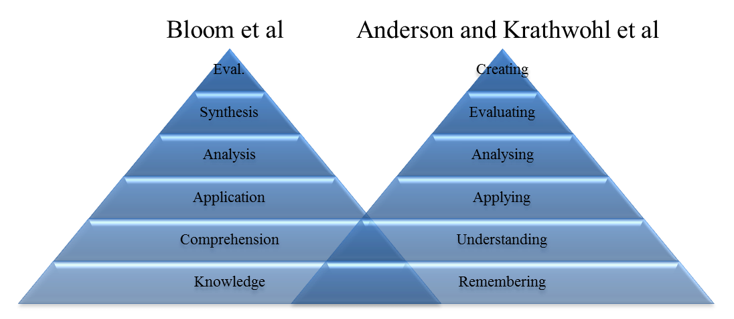
The key change in my teaching philosophy has been the realisation that motivating students should encourage a sense of independent intellectual development. This change in emphasis can be represented as a synthesis of two learning outcome hierarchies, proposed by Bloom et al (left pyramid) and Anderson & Krathwohl et al (right pyramid).
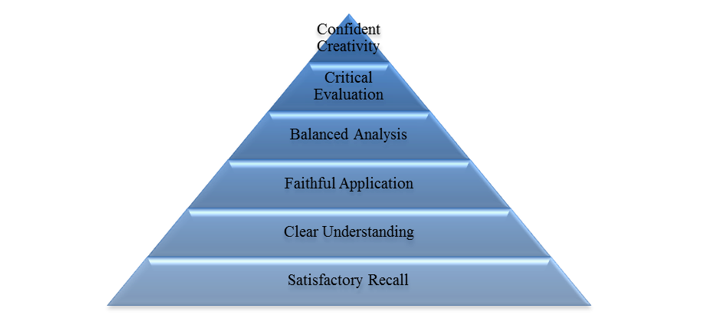
I propose a synthesis of these taxonomies, fleshed out with qualifying adjectives:
Including qualifying adjectives in Anderson & Krathwohl et al’s hierarchy allows us to assess the learning objectives in greater detail, with clearer observable implications. Adding an extra level of nuance to the concepts enriches their meaning, without losing the parsimony and clarity which are such key strengths of the original taxonomy. The addition of adjectives could be criticised as creating needless tautologies – if, for instance, we assume confidence is a necessary condition of creativity. However, creativity can be achieved without confidence if it is accidental and the student is unaware of the merits of their creativity. We need to aim for confident creativity because it is significantly more sustainable and transferable for a student to create in confidence than to be creative by accident or with heavy-handed guidance.
Transferring this approach to different contexts
Critical reflexivity is a very personal journey, and the results of my personal reflections may not be transferable. Even the phrase “teaching philosophy” connotes a sense of philosophy as retroactive rationalisation of one’s own perspective, as opposed to the analytic use of the term as a clear, open and rigorous system of thought. As Nancy Chism states, somewhat ironically, “One of the hallmarks of a philosophy of teaching statement is its individuality.” Whilst a teaching philosophy is developed through self-reflection, it requires self-awareness before it can be applied to others. Notably, teachers are somewhat unusual in their relationship with knowledge. They relish the acquisition of knowledge as an intrinsic good, where motivation to learn is rarely absent and the desire to contribute is second nature.
But what is good for the goose is not necessarily good for the gander. For many students school and college is first and foremost about acquiring qualifications, and therefore simply an instrument for career advancement. As such, not all students want to achieve distinction, nor see the value in risking creative contributions when a less resistant path exists. For such students there is a risk that emphasis on creativity will alienate them from the subject and the teacher. Furthermore, the development of my teaching philosophy has primarily taken place at an elite university, where boundary-pushing and intellectual confidence is far less risk-laden than in other contexts. The unflinchingly liberal environment at Oxford ascribes considerable value to intellectual creativity, perhaps at the expense of consolidation. Yet there is little utility in a teaching philosophy that is contingent on where and for whom it applies.
Nevertheless, these concerns are surmountable. Yes, academics perhaps have a gilded view of knowledge, but only because they have internalised the skills of contributing knowledge to the point where it has become (for the most part) a pleasure. It is incumbent on academics to encourage students towards a similar relationship with the world. Whilst not all students will want or feel able to contribute genuine insights, “confident creativity” is the apex of the pyramid and there are other levels of learning available to differentiate between learners. The ambition should be to encourage confident creativity, but “critical evaluation” or “balanced analysis” will be satisfactory outcomes for many students. Learners should not be forced to fit a teaching style that alienates them and a degree of differentiation between students will be required with the proviso that “confident creativity” is unambiguously the preferred goal and should be encouraged as far as possible.
Ultimately, the point of education is to equip individuals with the skills to speak for themselves. This is best achieved when we mix up teaching styles, and jolt work into study.
References
Anderson, L.W., Krathwohl, D.R., Airasian, P.W., Cruikshank, K.A., Mayer, R.E., Pintrich, P.R., Raths, J., & Wittrock, M.C. (eds) (2001) A Taxonomy for Learning, Teaching, and Assessing. (New York: Addison Wesley Longman Inc).
Bloom, B.S., Engelhart, M.D., Furst, E.J., Hill, W.H., & Krathwohl, D.R. (eds) (1956) Taxonomy of Educational Objectives: The Classification of Educational Goals – Handbook 1: Cognitive Domain. (London, WI: Longmans, Green & Co Ltd).
Chism, N. V. N. (1998) “Developing a Philosophy of Teaching Statement.” in Essays on Teaching Excellence 9(3) (Athens GA: Professional and Organizational Development Network in Higher Education).
Pratt, D.D., & Collins, J.B. (2000) ‘The teaching perspectives inventory: Developing and testing an instrument to assess teaching perspectives’ Proceeding of the 41st Adult Education Research Conference.
About the author
Dr Matthew Williams is Access Fellow at Jesus College, University of Oxford, where he teaches and conducts research in the field of political studies. Known as “the Welsh College”, Jesus College has a long history of working with schools in Wales and has recently taken on responsibility for delivering the university’s outreach and access programmes across all regions of Wales. Read more.
Live webinar: “Developing sustained effort in able learners”
On 2 July Dr Williams is leading a free webinar for NACE members in Wales, exploring approaches to developing confident creativity and motivating learners to be ambitious for themselves. This is part of our current series supporting curriculum development in Wales. Find out more and book your place.
In this article, originally published on the Psychology Today website, NACE patron Richard Bailey explores the problem(s) with praise…
There have been a number of reports and research articles trying to help teachers distinguish between effective and ineffective practices. One useful example comes from the University of Durham, when a team led by Professor Robert Coe reviewed a wide range of literature to find out what works, and what probably does not, in the Sutton Trust report What makes great teaching? Review of the underpinning research (2014).
Among the report’s examples of teaching techniques whose efficacy is not supported by research evidence was the widely discredited idea of "learning styles," as well as commonly used practices like "ability grouping" and "discovery learning." Even more surprising for many readers, perhaps, was the inclusion of "Use praise lavishly" in the list of questionable strategies. This is likely to be surprising because praise for students is seen as inherently affirming and beneficial by many people and is a core element of a positive philosophy of teaching, coaching, and parenting. In a similar way, criticism is now frequently condemned for being negative and harmful.
There are school programs and sports organisations based explicitly on the dual premises of plenty of praise and minimal criticism. And the rationale for this is usually that praise bolsters self-esteem and criticism harms it. In effect, this is the "gas gauge" theory of self-esteem, in which praise fills up the tank with good feelings and social approval, and criticism drains it.
Creating positive learning experiences
How can one not applaud the movement towards more positive approaches to education and sports? Especially for young people, these settings should be joyous, exciting experiences, and we know from vast amounts of research evidence from the United States and elsewhere that this is not always the case (link) (link).
We know, for example, that bullying, harassment and abuse still hide in dark corners, and that far too many parents, coaches, and teachers confuse infant needs with adult wants and infant games with professional competitions. We also know that such behaviours drive children away from engagement in and enjoyment of these pursuits because young people, if not all adults, know that learning, playing sports, and taking part in other activities are supposed to be fun.
Consider sports specifically for a moment. Research from the United States suggests that sports participation drops by 30% each year after age 10. According to a report from the National Alliance for Youth Sports, over 70% of children drop out of organised sports by age 13.
Numerous studies report that many children are put off participating in sports by an over-emphasis on winning and that this effect is especially strong among girls. Children are too often presented with a narrow and uninspiring range of opportunities, and while many love team games and athletic events, others find these traditional forms of physical activity irrelevant, boring, or upsetting.
Remember: this pattern of children dropping out from sports is happening as the health and happiness of young people are being compromised by unprecedented levels of physical inactivity. With activity levels low, and predicted to go even lower, we cannot afford to turn children off sports, and the movement toward more positive athletic experiences is undoubtedly a movement in the right direction.
There is a danger, though, in embracing praise as wholeheartedly and unconditionally as some parents, coaches, and teachers seem to have done.
When praise goes wrong…
Praise for students may be seen as affirming and positive, but a number of studies suggest that the wrong kinds of praise can be very harmful to learning. Psychologist Carol Dweck has carried out some of the most valuable research in this regard. In one study from 1998, fifth-graders were asked to solve a set of moderately difficult mathematical problems and were given praise that focused either on their ability ("You did really well; you're so clever") or on their hard work ("You did really well; you must have tried really hard”). The children were then asked to complete a set of more difficult challenges and were led to believe they had been unsuccessful. The researchers found that the children who had been given effort-based praise were more likely to show willingness to work out new approaches. They also showed more resilience and tended to attribute failure to lack of effort, not lack of ability. The children who had been praised for their intelligence tended to choose tasks that confirmed what they already knew, displayed less resilience when problems got harder, and worried more about failure.
What many might consider a common-sense approach – praising the child for being smart, clever, or "a natural" – turned out to be an ineffective strategy. The initial thrill of a compliment soon gave way to a drop in self-esteem, motivation, and overall performance. And this was the result of just one sentence of praise.
Some researchers have argued that praise that is intended to be encouraging and affirming of low-attaining students actually conveys a message of low expectations. In fact, children whose failure was responded to with sympathy were more likely to attribute their failure to lack of ability than those who were presented with anger. They claim:
“Praise for successful performance on an easy task can be interpreted by a student as evidence that the teacher has a low perception of his or her ability. As a consequence, it can actually lower rather than enhance self-confidence. Criticism following poor performance can, under some circumstances, be interpreted as an indication of the teacher's high perception of the student's ability.”
So, at the least, the perception that praise is good for children and criticism is bad needs a serious rethink: praise can hinder rather than help development and learning if given inappropriately. Criticism offered cautiously and wisely can be empowering.
Well-chosen criticism over poorly judged praise
These findings would seem to call for a reconsideration of a very widely held belief among teachers and coaches that they should avoid making negative or critical comments, and that if they must do so, then they should counter-balance a single criticism with three, four, or even five pieces of praise. This assumption is clearly based on the "gas gauge" model of self-esteem described earlier, viewing any negative comment as necessarily damaging, and requiring positive comments to be heaped around it in order to offset the harm.
I am unaware of any convincing evidence that criticism or negative feedback necessarily causes any harm to children's self-esteem. Of course, abusive comments and personal insults may well do so, but these are obviously inappropriate and unacceptable behaviours. Well-chosen criticism, delivered in an environment of high expectations and unconditional support, can inspire learning and development, whilst poorly judged praise can do more harm than good. Even relatively young children can tell the difference between constructive and destructive criticism, and it is a serious and unhelpful error to conflate the two.
We actually know quite a lot about effective feedback, and that knowledge is summarised nicely by the educational researcher John Hattie: "To be effective, feedback needs to be clear, purposeful, meaningful, and compatible with students’ prior knowledge, and to provide logical connections.”
I suggest that it would be extremely difficult to deliver feedback that is clear, purposeful, etc. in the context of voluminous praise. Eventually, the parent, teacher, or coach simply ends up making vague, meaningless or tenuous platitudes. And this can cause more damage to the learner-teacher relationship than criticism.
Build confidence by being present
The psychoanalyst Stephen Grosz describes a conversation he had with a school teacher named Charlotte Stiglitz – the mother of the Nobel prize-winning economist Joseph Stiglitz:
"I don't praise a small child for doing what they ought to be able to do," she said. "I praise them when they do something really difficult – like sharing a toy or showing patience. I also think it is important to say ‘thank you’, … but I wouldn't praise a child who is playing or reading.”
Grosz watched as a four-year-old Stiglitz showed her a picture he had been drawing. She did not do what many would have done (including me when I taught this age group) and immediately praise such a lovely drawing. Instead, she had an unhurried conversation with the child about his picture. “She observed, she listened. She was present,” Grosz noted.
I think Stephen Grosz’s conclusion from this seemingly everyday event is correct and important: being present for children builds their confidence by demonstrating that they are listened to. Being present avoids an inherent risk associated with excessive praise, as with any type of reward, that the praise becomes an end in itself and the activity is merely a means to that end. When that happens, learning, achievement, and the love of learning are compromised.
Praise is like sugar. Used too liberally or in an inappropriate way, it spoils. But used carefully and sparingly, it can be a wonderful thing!
Posted By Jon Murphy,
11 February 2019
Updated: 22 December 2020
NACE member and Challenge Award holder Llanfoist Fawr Primary School has developed a whole-school approach to character education, drawing on its use of the NACE Challenge Framework alongside the SkillForce Prince William Award. Headteacher Jon Murphy explains why the school believes so strongly in character education as a prerequisite for both wellbeing and academic success.
Why focus on character education?
Character education is not an add-on: it is essential for all young people, and the remit of all educators. Schools have a crucial role in preparing young people to withstand the pressures that life presents, to respond resiliently to setbacks and challenges, and to make informed decisions to shape their future lives. Character education provides the toolbox that will allow them to do so.
At Llanfoist Fawr Primary School, we also firmly believe that nurturing non-academic attributes such as resilience, determination and teamwork is a prerequisite to sound learning. Learning only takes place if the conditions are right and children can cope with the pressures and challenges thrown up by school and life beyond school. And until an individual knows themselves and feels happy in their own skin, they cannot fully realise what they are capable of.
Developing a whole-school approach to character education has unequivocally proved to us that this kind of holistic development is essential in preparing children to become effective learners in all areas, be it academic, sporting, artistic, cultural, spiritual, musical or social.
This goes hand in hand with our use of the NACE Challenge Framework – recognising the importance of character education as a foundation for all learners to develop and achieve at the highest levels of which they are capable.
What does character education look like at Llanfoist Fawr?
There is no single method for developing character-based curriculum provision. At Llanfoist we have aligned our character education work with the NACE Challenge Framework and with the SkillForce Prince William Award (PWA), for which we were selected as a pilot school. The PWA and NACE Challenge Framework complement and enhance each other perfectly, ensuring challenge for all.
External PWA instructors provide whole-class sessions, each exploring a character attribute or “guiding principle” such as reliance, courage or passion. The PWA explores 28 guiding principles through five key themes – personal development, relationships, working, community and environment – using experiential learning. Children engage in practical skills-based activities and are encouraged to review their actions and behaviour in accordance with the guiding principles.
How is this integrated with other areas of learning?
Character development is not a standalone programme and will not succeed as such; it will only succeed in developing productive character traits if it is an integral part of everything we do and everything we believe in.
Once a guiding principle and its associated behaviours have been taught in a PWA session, children are encouraged to use and apply that character skill across the curriculum. At every opportunity the class teacher reinforces the principles and applies them to other areas of learning.
The impact can be seen in every lesson; we see children become more resilient, self-regulating and develop self-belief. The guiding principles and associated behaviours become second nature as learners assimilate, value and live them.
What has been the impact for more able learners, and all learners?
Developing character has transformed the life chances of many of our pupils, including the more able, helping to equip them with the social, emotional and academic skills needed to succeed.
As with many of the most effective influencers in education, the impact cannot be measured in a number or score. The results have been seen in the children’s improved emotional health, wellbeing and view of themselves; the happiness they gain through productive learning; the self-belief and confidence that positively radiates from young people who are comfortable in their own skins and daring to be their “best selves”.
Character development allows learners to discover previously untapped inner strength, skills, talents and self-belief. It has empowered children in our school to understand how best to lead their own learning, to make strong moral choices and to be confident, independent decision makers. Our more able realise what potential they have and are enthusiastic engaged leaders and learners who thrive on the challenges and opportunities afforded them.
As a school we seek innovative, creative and fun approaches to curriculum delivery with guaranteed high-impact learner outcomes. Developing character education has delivered on all fronts.

 Blog Home
 All Blogs
 Print Page
 RSS
RSS