Guidance, ideas and examples to support schools in developing their curriculum, pedagogy, enrichment and support for more able learners, within a whole-school context of cognitively challenging learning for all. Includes ideas to support curriculum development, and practical examples, resources and ideas to try in the classroom. Popular topics include: curriculum development, enrichment, independent learning, questioning, oracy, resilience, aspirations, assessment, feedback, metacognition, and critical thinking.
Dr Robin Bevan, Headteacher, Southend High School for Boys (SHSB)
One of the underlying tests of whether a student has fully mastered a new area of learning is whether they have the capacity to “self-regulate the production of quality responses” in that domain. At its simplest level, this would be knowing whether an answer is right or not, without reference to any third party or expert source. This develops and extends into whether the student can readily assess the validity of the reasoning deployed in replying to a more complex question. And, at its highest level, the student would be able to articulate why one response to a higher-order question is of superior quality than another.
Framed in another way, we teach to ensure that our pupils know how to answer questions correctly, know what makes their responses sound and, ultimately, understand the distinguishing features of the best quality thinking relevant to the context (and, by this I mean far more than just the components of a GCSE mark scheme).
This hierarchy of desired learning outcomes not only provides an implicit structure for differentiating task outcomes, but also gives a strong steer regarding our approaches to feedback for the most able learners. Our intention for our most able learners is that they can reach the highest level of critical understanding with each topic. This is so much more than just getting the answers right and hints at why traditional tick/cross approaches to marking have often proved so ineffective (Ronayne: 1999).
These comments may be couched in different language, but there is a deep resonance between my observations and the clarion call – over two decades ago – for increased formative assessment that was published as Inside the Black Box (Black and Wiliam, 1998):
Many of the successful innovations have developed self- and peer-assessment by pupils as a way of enhancing formative assessment, and such work has achieved some success with pupils from age five upwards. This link of formative assessment to self-assessment is not an accident – it is indeed inevitable.
To explain this, it should first be noted that the main problem that those developing self-assessment encounter is not the problem of reliability and trustworthiness: it is found that pupils are generally honest and reliable in assessing both themselves and one another, and can be too hard on themselves as often as they are too kind. The main problem is different – it is that pupils can only assess themselves when they have a sufficiently clear picture of the targets that their learning is meant to attain. Surprisingly, and sadly, many pupils do not have such a picture, and appear to have become accustomed to receiving classroom teaching as an arbitrary sequence of exercises with no overarching rationale. It requires hard and sustained work to overcome this pattern of passive reception. When pupils do acquire such an overview, they then become more committed and more effective as learners: their own assessments become an object for discussion with their teachers and with one another, and this promotes even further that reflection on one's own ideas that is essential to good learning.
What this amounts to is that self-assessment by pupils, far from being a luxury, is in fact an essential component of formative assessment. Where anyone is trying to learn, feedback about their efforts has three elements – the desired goal, the evidence about their present position, and some understanding of a way to close the gap between the two (Sadler: 1989). All three must to a degree be understood before they can take action to improve their learning. (Black & Wiliam, 1998)
Understanding the needs of the more able: a tragic parody
Sometimes an idea can become clearer when we examine its opposite: when, that is, we illuminate how the more able learner can be starved of effective feedback. To illustrate this as powerfully as possible, I am going to employ a parody. It is a tragic parody, in that the disheartening description of teaching and learning that it includes is both frustratingly common and yet so easily amenable to fixing. Imagine the following cycle of teacher and pupil activity.
The teacher identifies an appropriate new topic from the scheme of work. She delivers an authoritative explanation of the key ideas and new understanding. It is an accomplished exposition and the class is attentive.
A set of response tasks are set for the class. These are graduated in difficulty. Every pupil is required to work in silence, unaided – after all, it has just been explained to them all! Each pupil starts with the first question and continues through the exercise. The work is completed for homework.
The teacher collects in the homework, marks the work for accuracy of answers with a score out of 10.
In the next lesson, the class is given oral feedback by the teacher on the most common errors. The class proceeds to the next topic. The cycle then repeats.
This is probably not far removed from the way in which many of us were taught, when we were at school. Let us examine this parody from the perspective of the more able.
It is highly likely that the more able pupil already knows something, or a great deal, about this topic. Nonetheless, complicit in this well-rehearsed didactic model, the most able pupil sits through the teacher’s presentation, patiently. A good proportion of this time is essentially wasted.
Silent working prohibits the development of understanding that comes through vocal articulation and discussion. The initially easy exercise prevents, by its very design, the most able from exploring the implications and higher consequences of the topic. The requirement to complete all the questions, even the most simple, fills the time – unproductively. Then, the whole class faces the challenge of completing the harder questions, unsupported, away from the teacher’s expert assistance. For the most able, these harder questions are probably the richest source of potential new learning. But it is no surprise that for the class as a whole the success rate on the harder questions is limited.
The most able pupil gains 8 or 9 out of 10; possibly even an ego-boosting 10. The pupil feels good and is inclined to see the task as a success. Meanwhile, all the items that are discussed by the teacher were questions that everyone else got wrong, not the learning that is needed to extend or develop the more able pupil.
A new topic is started. The teacher has worked hard. The class has been well-behaved. The able pupil has filled their time with active work. And yet, so little has been learned.
Unravelling the parody
This article is intended to focus on the most effective forms of feedback for the more able learner; but it is clear from the parody that we are unlikely to create the circumstances for such high-quality feedback without considering, alongside this, elements such as: the diagnostic assessment of prior learning, structured lesson design, optimal task selection, and effective homework strategies. Each of these, of course, warrants an article of its own.
However, we cannot escape the role of task design altogether in effective feedback. A variety of routine approaches, often suited for homework, allow students to become accustomed to the process of determining the quality of what might be expected of their assignments. For example:
a. Rather than providing marked exemplars, pupils are required to apply the mark scheme to sample finished work. Their marking is then compared (moderated), before the actual standards are established. This ideally suits extended written accounts and practical projects.
b. Instead of following a standard task, pupils are instructed to produce a mark scheme for that task. Contrasting views and key features of the responses are developed; leading to a definitive mark scheme. (It may then be appropriate to attempt the task, or the desired learning may well have already been secured.) This ideally suits essays and fieldwork.
c. These approaches may be adapted by supplying student work to be examined by their peers: “What advice would you give to the student who produced this?” “What misunderstanding is present?” “How would you explain to the author the reasons for their grade?” This ideally suits more complex conceptual work, and lines of reasoning.
d.As a group activity, parallel assignments may be issued: each group being required to prepare a mark scheme for just one allocated task, and to complete the others. Ensuring that the mark schemes have been scrutinised first, the completed tasks are submitted for assessment to the relevant group. This ideally suits examination preparation.
Although these are whole-class activities, they are particularly suited to the more able learner as they give access to higher-order reflective thinking and the tasks are oriented around the issue of “what quality looks like”.
Marking work or just marking time?
Teachers spend extended hours marking pupils’ work. It is a common frustration amongst colleagues that these protracted endeavours do not always seem to bear fruit. There are lots of reasons why we mark, including: to ensure that work has been completed; to determine the quality of what has been done; and to identify individual and common errors for immediate redress.
The list could be extended, but should be reviewed in the light of one pre-eminent question: to what extent does this marking enhance pupils’ learning? The honest answer is that there are probably a fair number of occasions when greater benefit could be extracted from this assessment process.
The observations of Ronayne (1999) illustrate this concern and have clear implications for our professional practice with all learners, but perhaps the most able in particular. In his study, Ronayne found that when teachers marked pupils’ work in the conventional way in exercise books, an hour later, pupils recalled only about one third of the written comments accurately – although they recalled proportionately more of the “constructive” feedback and more of the feedback related to the learning objectives.
Ronayne also observed that a large proportion of written comments related to aspects other than the stated learning objectives of the task. Moreover, the proportion of feedback that was constructive and related to the objectives was greater in oral feedback than written; but as more lengthy oral feedback was given, fewer of the earlier comments were retained by the class. In contrast, individual verbal feedback, as opposed to whole-class feedback, improved the recollection of advice given.
So what then should we do?
It is usually assumed that assessment tasks will be designed and set by the teacher. However, if students understand the criteria for assessment in a particular area, they are likely to benefit from the opportunity to design their own tasks. Thinking through what kinds of activity meet the criteria does, itself, contribute to learning.
Examples can be found in most disciplines: pupils designing and answering questions in mathematics is easily incorporated into a sequence of lessons; so is the process of identifying a natural phenomenon that demands a scientific explanation; or selecting a portion of foreign language text and drafting possible comprehension questions.
For multiple reasons the development of these approaches remains restricted. There is no doubt that teachers would benefit from practical training in this area, and a lack of confidence can impede. However, it is often the case that teachers are simply not convinced of the potency of promoting self-regulated quality expertise.
A study in Portugal, reported by Fontana and Fernandes in 1994, involved 25 mathematics teachers taking an INSET course to study methods for teaching their pupils to assess themselves. During the 20-week part-time course, the teachers put the ideas into practice with a total of 354 students aged 8-14. These students were given mathematics tests at the beginning and end of the course so that their gains could be measured. The same tests were taken by a control group of students whose mathematics teachers were also taking a 20-week part-time INSET course but this course was not focused on self-assessment methods. Both groups spent the same time in class on mathematics and covered similar topics. Both groups showed significant gains over the period, but the self-assessment group's average gain was about twice that of the control group. In the self-assessment group, the focus was on regular self-assessment, often on a daily basis. This involved teaching students to understand both the learning objectives and the assessment criteria, giving them an opportunity to choose learning tasks, and using tasks that gave scope for students to assess their own learning outcomes.
Other studies (James: 1998) report similar achievement gains for students who have an understanding of, and involvement in, the assessment process.
One of the distinctive features of these approaches is that the feedback to the student (whether from their own review, from a peer or from the teacher) focuses on the next steps in seeking to improve the work. It may be that a skill requires practice, it may be that a concept has been misunderstood, that explanations lack depth, or that there is a limitation in the student's prior knowledge.
Whatever form the feedback takes, it loses value (and renders the assessment process null) unless the student is provided with the opportunity to act on the advice. The feedback and the action are individual and set at the level of the learner, not the class.
In a similar vein, approaches to “going through” mock examinations and other tests require careful preparation. Teacher commentary alone, whilst resolving short-term confusion, is unlikely to lead to long-term gains in achievement. Alternatives are available:
i. Pupils can be asked to design and solve equivalent questions to those that caused difficulty;
ii.Pupils can, for homework, construct mark schemes for questions requiring a prose response, especially those which the teacher has identified as having been badly answered;
iii.Groups of pupils (or individuals) can declare themselves “experts” for particular questions, to whom others report for help and to have their exam answers scrutinised.
Again, in each of these practical approaches the most able are positioned close to the optimal point of learning as they articulate and demonstrate their own understanding for themselves or for others. In doing so, they can confidently approach the self-regulated production of quality answers.
Further reading
Black, P. & Wiliam, D. (1998). Inside the Black Box: Raising standards through classroom assessment. School of Education, King’s College, London.
Fontana, D. and Fernandes, M. (1994). ‘Improvements in mathematics performance as a consequence of self-assessment in Portuguese primary school children’. British Journal of Educational Psychology. Vol. 64 pp407-17.
James, M. (1998) Using Assessment for School Improvement. Heinemann, Oxford.
Ronayne, M. (1999). Marking and Feedback. Improving Schools. Vol. 2 No. 2 pp42–43.
Sadler, R. (1989). Formative assessment and the design of instructional systems. Instructional Science. Vol. 18 pp119-144.
NACE Curriculum Develop Director Dr Keith Watson is presenting a webinar on feedback on Friday 19 March 2021, as part of our Lunch & Learn series. Join the session live (with opportunity for Q&A) or purchase the recording to view in your own time and to support school/department CPD on feedback. Live and on-demand participants will also receive an accompanying information sheet, providing an overview of the research on effective feedback, frequently asked questions, and guidance on applications for more able learners. Find out more.
In recent years many new developments in teaching have been most welcome and have helped the shift towards a more research-informed profession. NACE’s recent report Making space for able learners – Cognitive challenge: principles into practice provides examples of strategies used for the design and management of cognitively challenging learning opportunities, including reference to Rosenshine’s Principles of Instruction (2010) which outline many of these strategies.
These principles of instruction are particularly influential in current teaching, which is pleasing to the many good teachers who have been used them for years, although they may not have attached that exact language to what they were doing. These principles are especially helpful for early career teachers, but like all principles they need to be constantly reflected upon. I was always taken by Professor Deborah Eyre’s reference to “structured tinkering” (2002): not wholesale change but building upon key principles and existing practice.
This is where “cutaway” comes in – another of the strategies identified in the NACE report, and one which I would like to encourage you to “tinker” with in your approach to ability grouping and ensuring appropriately challenging learning for all.
What is “cutaway” and why use it?
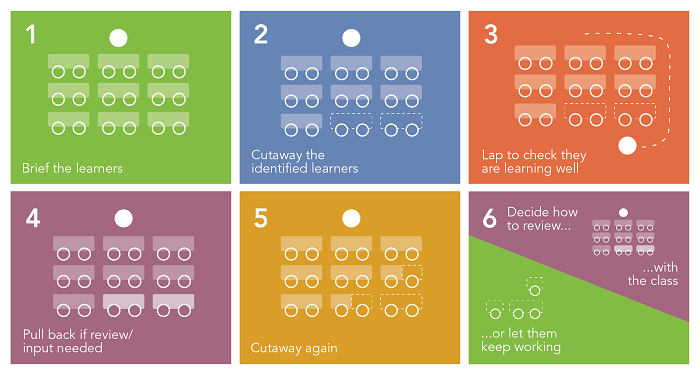
The “cutaway” approach involves setting high-attaining students off to start their independent work earlier than the vast majority of the class, while the teacher continues to provide direct instruction/ modelling to the main group. In this way the high attainers can begin their independent work more quickly and can avoid being bored by the whole class instruction which they can find too easy, even when the teacher is trying to “teach to the top”. Once the rest of the class has begun their independent work, the teacher can then focus on the higher attaining group to consolidate the independent work and extend them further.
There are more nuances which I will explain later, but you may wonder, how did this way of working come about?
An often-quoted figure from the National Academy of Gifted and Talented Youth (NAGTY) was that gifted students may already have acquired knowledge of 40-50% of their lessons before they are taught. If I am honest, this was 100% in some of my old lessons! With whole class teaching, retrieval practice tasks and modelling (all essential elements in a lesson), there are clear dangers of pupils being asked to work on things they already know well. There is the issue of what Freeman, (quoted in Ofsted, 2005:3), called the “three-time problem” where: “Pupils who absorb the information the first time develop a technique of mentally switching off for the second and the third, then switching on again for the next new point, involving considerable mental skill.” Why waste this time?
The idea of “cutaway” was consolidated when I carried out a research project involving the use of learning logs to improve teaching provision for more able learners (Watson, 2005). In this project teachers adapted their teaching based on pupil feedback. The teachers realised that, in a primary classroom, keeping the pupils too long “on the carpet” was inappropriate and the length of time available to work at a high level was being minimised. One of the teachers reflected: “Sometimes during shared work on the carpet, when revising work from previous lessons to check the understanding of other pupils, I feel aware of the more able children wanting to move on straight away and find it difficult to balance the needs of all the children within the Year 5 class.”
It therefore became common in lessons (though not all lessons) to cutaway pupils when they were ready to begin independent work. By using “cutaway” the pupils use time more effectively, develop greater independence, can move through work more quickly and carry out more extended and more challenging tasks. The method was commented upon favourably during a HMI inspection that my school received and has ever since been a mainstay of teaching at the school.
Who, when and how to cutaway
So how does a teacher decide when and who to cutaway? The method is not needed in all lessons, the cutaway group should vary based upon AfL, and at its best it involves pupils deciding whether they feel they need more modelling/explanation from the teacher or are ready to be cutaway. In a recent NACE blogpost on ability grouping, Dr Ann McCarthy emphasises that in using cutaway “the teacher constantly assesses pupils’ learning and needs and directs their learning to maximise opportunities, growth and development” and pupils “leave and join the shared learning community”. This underlines the importance of the AfL nature of the strategy and the importance of developing learners’ metacognition, which was another key finding in the NACE report.
Sometimes the cutaway approach is decided on before a lesson by the teacher based upon previous work. In GCSE history, a basic retrieval task on the Norman invasion could be time wasted for a more able pupil who has secure knowledge, whereas being cutaway to do an independent task centred on the role of the Pope in supporting William would be more challenging and worthwhile. It comes down to one key question a teacher needs to ask themselves when speaking to the whole class: “Who do I need here now?” Who needs to retrieve this knowledge? Who needs to hear this explanation? Who needs to see this model or complete this example? If a small group of higher attainers do not need this, then why slow the pace of their learning? Why not start them either on the same work independently or more challenging work to accelerate learning?
Why not play around with this idea? Explain your thinking to the pupils and see how they respond. Sometimes, at the end of one lesson, a task for the next lesson can be explained and the pupils could start the next lesson by working on that task straight away. The 2015 Ofsted handbook said, “The vast majority of pupils will progress through the programmes of study at the same rate”, and ideally, they will. However, a few pupils will progress at a faster rate and therefore need adapted provision. The NACE research and accompanying CPD programme suggests the use of “cutaway” can achieve this and it is well worth all teachers doing some “structured tinkering” with this strategy.
References
Eyre, D. (2002). Structured Tinkering: Improving Provision for the Gifted in Ordinary Schools. Gifted & Talented International 22(1):31-28.
Emma Sanderson, Head of English at NACE member and Challenge Award-accredited Hartland International School (Dubai), shares advice for successful use of “Genius Hour” project-based learning to challenge and motivate learners, inspired by Google’s “20% time”.
As teachers, our awareness of the importance of challenging questions is always at the forefront of our minds, particularly with our more able learners. However, the onus of asking challenging questions shouldn’t always be placed on the teacher. Cue Genius Hour, an idea inspired by Google’s “20% time”, in which employees are encouraged to spend 20% of their time working on any project of their choosing, on the condition that it ultimately benefits the company in some way, and which is famously credited with giving rise to many of Google’s most successful innovations.
Google’s “20% time” is similar to the use of Genius Hour in our school: encouraging students to take ownership of their learning by using a proportion of curriculum time to focus on topics they are passionate about. By coming up with their own driving question to focus their research, students manage their own learning journey and subsequently become even more engaged with the learning process.
Here are three key steps to use Genius Hour project-based learning effectively:
1) Support students to develop their driving question.
The driving question of the project will become the focus of the students’ research. Whilst students may be tempted to simply find out more information about a topic close to their heart, the key is to construct a question that allows for in-depth research and is also broad enough for students to include their personal opinions. Even our most able learners will need support with this task, and for this, question stems can be incredibly useful:
What does _______ reveal about _________?
To what extent does…?
What motivates_________?
How would you develop…?
What alternatives are there for…?
How can technology be used to…?
What assumptions are there about…?
What are the [ethical] implications of…?
How can we challenge…?
What would happen if…?
How can we improve…?
What might happen if…?
Students might be encouraged to come up with solutions to real-life problems or delve into ideas linked to current affairs that they are intrigued by. Either way, these broad question stems allow for thorough exploration of a topic.
2) Help students develop their research skills.
Left to their own devices, students may be tempted to simply Google their question and see what answers come up. Instead, offer guidance on the best and most reliable sources of information for their project.
It may be that students are directed towards relevant reference books in the library. Additionally, online resources can prove invaluable; the Encyclopaedia Britannica offers a wealth of knowledge for students, whilst news websites aimed at teenagers (for example Newsela and The Day) encourage students to form their own opinions on current affairs and offer suggestions for further reading.
Our more able learners may be more adept at focusing their internet searches and filtering through the vast array of results. If this is the case, students would be expected to determine whether a source is reliable or biased and should be confident at citing their sources.
3) Encourage creativity in how students present their findings.
Ideally, students will be excited and motivated to complete their Genius Hour project, and originality in how they present their results should be encouraged. Students may want to create a video, make a presentation, write a passionate and persuasive speech, design an informative leaflet… The more freedom the students have, the more their creativity will flourish.
One of our students gave a rousing speech on the question, “What alternatives are there to living on planet Earth?” (ultimately concluding there were none and that we need to change our lifestyles in order to save the planet). Another offered a passionate presentation on the theme “How can we improve Earth’s biodiversity while allowing people to still eat meat and plants?” And after witnessing the impact of Covid-19 first hand, one student wrote an insightful article to answer the question, “What has Covid-19 revealed about our society in 2020?”
This approach to project-based learning can also be effectively applied during distance learning – students can be given the success criteria for the project and set the challenge of managing their own time. There is ample opportunity to use technology to give presentations remotely, either live through Zoom or Teams, or recorded individually using a platform such as Flipgrid.
In summary…
Overall, Genius Hour is a fantastic tool to promote deeper thinking in the classroom, whilst also having huge benefits across the wider curriculum. We have found this approach has worked particularly well with Key Stage 3 students and is the perfect opportunity to refine the research and presentation skills required at GCSE, whilst also impacting positively across the curriculum in all lessons. Furthermore, it sends the message to students that their passions outside of school are valued, which in itself can prove to be hugely motivational. Presenting their findings at the end of the project instils confidence in our learners, giving them the vital communication, leadership and time management skills necessary for life beyond education.
Further reading: “Cognitive challenge: principles into practice”
NACE’s report “Cognitive challenge: principles into practice” explores approaches to curriculum and pedagogy which optimise the engagement, learning and achievement of very able young people, combining relevant research and theory with examples of current practice in NACE Challenge Award-accredited schools. Preview and order here.
Alison Tarrant, Chief Executive, School Library Association (SLA)
I struggle with addressing the importance of diversity accurately, but fundamentally I think Ruth Bader Ginsberg sums it up best:
“When I'm sometimes asked when will there be enough [women on the Supreme Court] and I say, 'When there are nine,' people are shocked. But there'd been nine men, and nobody's ever raised a question about that.”
Every child should read about how other children live and about alternative experiences, and I don’t think we should limit this to a certain percentage or context. Until children can pick up a book and not be surprised that a character looks like them (or doesn’t look like them), we have work to do. It’s vital that the resources children engage with are noticeably representative (there are many studies which show even animals are more likely to be male in books, so the argument that animals or monsters are equally representative doesn’t work). For more on this, watch the SLA's webinar "Representation for All" – available for NACE members until the end of January 2021.
If we look at BookTrust Represents' interim research and CLPE’s Reflecting Realities survey of ethnic representation in UK children’s literature, both report some positive progress in recent years:
3% growth in the number of authors and illustrators of colour published in the UK in the last two years.
7% of the children’s books published in the UK over the last three years feature characters of colour.
This is progress, but the pace of change doesn’t yet seem to match the level of the discussion which has taken place. I’m hopeful that the new initiatives launched in light of the events of this year will lead to a significant increase on these figures next year. In the meantime, how can schools ensure their resources are diverse, representative and inclusive?
Key questions to consider
For many schools, the topic of diversity and inclusion prompted self-evaluation this year. An audit of the curriculum and/or resources may have taken place, though this can be done in many different ways. Here are some core questions to ask when thinking about diversity within your resources:
How many of your resources are written by ethnic minorities or people seen less in the public eye? This may include consideration for UK-based ethnic minorities, authors with disabilities, authors from working-class backgrounds.
How many of the resources reflect stories from these groups? When thinking about this, consideration should also be given to how those characters are represented; if every story which includes a black character shows them suffering abuse, it embeds a story overall. Are these stories “issues” stories, or simply great stories with authentic characters? Are they suitable for discovery alone, or do they need a conversation and some scaffolding beforehand? (There was a very interesting and upsetting discussion around the impact of “Of Mice and Men” on pupils and teachers recently – you can read it about it in this Twitter thread.)
How often do you create displays around these characters, authors, books? Celebrate these authors alongside their mainstream colleagues, rather than as part of Black History Month or awareness days, as consistently “including” them in this way may actually send a message of “othering” as opposed to inclusion.
Are your resources providing a broad range of experiences and perspectives? Match the resources to the cohort, absolutely, but include resources for wider awareness as well. For example, resources about travellers are important for the travelling community; but they’re also important for representing an alternative narrative to the stereotype which is so easily absorbed, so should also be available in schools without those cohorts.
Is your school collection keeping pace? Ensuring representation and inclusion doesn’t happen by accident. It requires an in-depth knowledge of the school’s resource collection, it can be supported or hindered by the collection policy, and it does require funding. There are equity issues with schools which are not funding their resources sufficiently; these schools are often pushed to get resources from donations or charity shops, and while there may be an occasional bargain to be found, these should not form the basis of a collection. Publishers have been increasingly proactive in paying attention to these issues, and are constantly scanning and reacting to the world around them. The books produced in the last year or two will take a long time to filter through to donations (most often as children grow up or out of books), so if schools rely on donations/second-hand purchases, this delays the impact of changes and leaves some children missing out.
Note on diversity in resource formats
Diversity should also be reflected in the type of resource encountered. Throughout this blog I’ve used the word resources instead of “book” – this is not just because schools should be considering all their resources, but also because “book” can be taken to have a very narrow meaning. Resources, in this blog, means fiction books, information books, e-books, audio books, graphic novels, poetry books, wordless books, picture books and much more. Teachers are incredibly good at selecting the right resource for the right piece of work, but we also need to be mindful of the overall messaging when all those resources are put together, and those with responsibility for the school library need to make sure that representation, inclusion, and importantly choice, are available to all pupils.
Further reading and resources
Free webinar: "Representation for All". The SLA has written multiple articles on this topic and provided a free webinar for SLA members. The webinar recording is available for NACE members until the end of January 2021. Watch the webinar here.
Share your views: UK School Library Survey 2020. The SLA is partnering with Softlink on a survey into key issues for school libraries in 2020; and indeed one of the questions is about how schools and school libraries have responded to the varying key themes of this year. Children are curious and will have had a huge number of questions about different things throughout this year; schools are key allies in supporting their learning journey through these cultural issues, and we’d like to know how these subjects have been tackled. Take part in the survey here.
Blog post: Librarians under lockdown: rising to the challenge– Bev Humphrey, Literacy and Technology Consultant and Digital Content Manager at the SLA, shares some of the ways in which school librarians have risen to meet the challenges of lockdown life.
New reading list for able readers at KS3. NACE trustee Sue Mordecai has compiled a list of recommended reading for able readers in key stage 3, available in the templates and checklists section of the NACE members' resource library (login required). This is a working list and one we will continue adding to. To share your suggestions for this list, or for other age groups, please contact communications@nace.co.uk.
Dr Ann McCarthy, NACE Associate and co-author of NACE’s new publication “Cognitive challenge: principles into practice”.
When you’re planning a lesson, are your first thoughts about content, resources and activities, or do you begin by thinking about learning and cognitive challenge? How often do you consider lessons from the viewpoint of your more able pupils? Highly able pupils often seek out cognitively challenging work and can become distressed or disengaged if they are set tasks which are constantly too easy.
NACE’s new research publication, “Cognitive challenge: principles into practice”, marks the first phase in our “Making Space for Able Learners” project. Developed in partnership with NACE Challenge Award-accredited schools, the research examines the impact of cognitive challenge in current school practice against a backdrop of relevant research.
What do we mean by ‘cognitive challenge’?
Cognitive challenge can be summarised as an approach to curriculum and pedagogy which focuses on optimising the engagement, learning and achievement of highly able children. The term is used by NACE to describe how learners become able to understand and form complex and abstract ideas and solve problems. Cognitive challenge prompts and stimulates extended and strategic thinking, as well as analytical and evaluative processes.
To provide highly able pupils with the degree of challenge that will allow them to flourish, we need to build our planning and practice on a solid foundation.
This involves understanding both the nature of our pupils as learners and the learning opportunities we’re providing. When we use “challenge” as a routine, learning will be extended at specific times on specific topics – which has useful but limited benefit. However, by strategically building cognitive challenge into your teaching, pupils’ learning expertise, their appetite for learning and their wellbeing will all improve.
What does this look like in practice?
The research identified three core areas:
1. Design and management of cognitively challenging learning opportunities
In the most successful “cognitive challenge” schools, leaders have a clear vision and ambition for pupils, which explicitly reflects an understanding of teaching more able pupils in different contexts and the wider benefits of this for all pupils. This vision is implemented consistently across the school. All teachers engage with the culture and promote it in their own classrooms, involving pupils in their own learning. When you walk into any classroom in the school, pupils are working to the same model and expectation, with a shared understanding of what they need to do.
Pupils are able to take control of their learning and become more self-regulatory in their behaviours and increasingly autonomous in their learning. Through intentional and well-planned management of teaching and learning, children move from being recipients in the learning environment to effective learners who can call on the resources and challenges presented. They understand more about their own learning and develop their curiosity and creativity by extending and deepening their understanding and knowledge.
2. Rich and extended talk and cognitive discourse to support cognitive challenge
The importance of questions and questioning in effective learning is well understood, but the importance of depth and complexity of questioning is perhaps less so. When you plan purposeful, stimulating and probing questions, it gives pupils the freedom to develop their thought processes and challenge, engage and deepen their understanding. Initially the teacher may ask questions, but through modelling high-order questioning techniques, pupils in turn can ask questions which expose new ways of thinking.
This so-called “dialogic teaching” frames teaching and learning within the perspective of pupils and enhances learning by encouraging children to develop their thinking and use their understanding to support their learning. Initially, pupils might use the knowledge the teacher has given them, but when they’re shown how to use classroom discourse effectively, they’ll start to work alone, with others or with the teacher to extend their repertoire.
By using an enquiry-orientated approach, you can more actively engage children in the production of meaning and acquisition of new knowledge and your classroom will become a more interactive and language-rich learning domain where children can increase their fluency, retrieval and application of knowledge.
3. Curriculum organisation and design
How can you ensure your curriculum is organised to allow cognitive challenge for more able pupils? You need to consider:
What is planned for the students
What is delivered to the students
What the students experience
Schools with a high-quality curriculum for cognitive challenge use agreed teaching approaches and a whole-school model for teaching and learning. Teachers expertly and consistently utilise key features relating to learning preferences, knowledge acquisition and memory.
Planning a curriculum for more able pupils means providing a clear direction for their learning journey. It’s necessary to think beyond individual subjects, assessment systems, pedagogy and extracurricular opportunities, and to look more deeply at the ways in which these link together for the benefit of your pupils. If teachers can understand and deliver this curriculum using their subject knowledge and pedagogical skills, and if your school can successfully make learning visible to pupils, you’ll be able to move from well-practised routines to highly successful and challenging learning experiences.
Taking it further…
If we’re going to move beyond the traditional monologic and didactic models of teaching, we need to recast the role of teacher as a facilitator of learning within a supportive learning environment. For more able pupils this can be taken a step further. If you can build cognitive challenge into your curriculum and the way you manage learning, and support this with a language-rich classroom, the entire nature of teaching and learning can change. Your highly able pupils will become increasingly autonomous and more self-reliant. They’ll become masters of their learning as they gain a deeper understanding of the subject matter. You can then extend your role even further, from learning facilitator to “learner activator”.
This blog post is based on an article originally written for and published by Teach Primary magazine – read the full version here.
For all of us in the teaching profession, September 2020 has been a return to school we are unlikely to forget for many years. Amongst the struggles, anxieties and restrictions of the COVID-19 pandemic, schools across the UK have reopened to all pupils, and teachers have found themselves at the centre of media and political scrutiny as they attempt to craft and deliver a ‘recovery curriculum’ for learners. There is a balance required between addressing and supporting pupil wellbeing, whilst assessing the impact of four months of school closure on educational attainment. As much as I read about ‘lost time’, ‘regression’ and ‘recovery’, the reality of being back in the classroom has, for me, brought about many different questions: Where are these learners at now? How can I best support them? And perhaps more importantly, do I need to change my expectations of where they should be and how well they will progress? These questions are all pertinent for more able learners, many of whom have worked consistently and independently at home throughout the lockdown.
I find myself thinking… no. Perhaps a ‘recovery curriculum’ is not what these children really need. Instead, do learners need the consistency they have come to expect from their teachers and schooling? A consistency of “keeping standards high for everyone” (Sherrington, p148) will ensure that our expectations of all learners, and particularly our more able learners, are behind all the decisions we make regarding curriculum. I am reminded of a TES article I read in April 2020 headlined ‘Dumb down at your peril!’ As practitioners, we need to ensure that we do not inadvertently add to the time lost by lowering our standards and expectations of learners. If learning really does “require forgetting” (Wiliam, 2016) then the classroom becomes an exciting place for innovation this year as we are able to move learners forward in a new way, ensuring our teaching focus is on moving forward, rather than looking back. (For additional perspectives on this, take a look at NACE’s free “beyond recovery” resource pack.)
Here are five practical ways I’ve been putting this approach into practice:
1.Encourage learners to explore and share their passions
For many more able learners, the time spent at home will have been a positive experience. The additional time to explore their passions (reading, writing, painting, problem solving) and really delve into areas of interest is something that school often struggles to provide. I believe that our “curriculum is more than the lessons” (Waters, 2020) and so taking the time to talk with more able learners about their experiences during lockdown is vital. This insight allows us to plan tasks where the pupil becomes the expert, e.g. the learner leading a class session, teaching others about their talent, sharing their work (writing, art) or creating a ‘how to’ guide/video which can be used by their peers. (I’ve found this has been particularly successful with classroom mathematics and learners with sporting talent.)
2.Draw on current events to develop independent thought and debate
Many more able learners are likely to have high levels of interest in contemporary issues surrounding the pandemic. In my experience, these children (even at age 10 and 11) are beginning to form and question their own opinions, undertaking their own research, watching the news and reading online, and engaging in discussion (often with adults) at home. Harnessing these issues in the classroom provides an opportunity to teach “creative and critical thinking” (one of the 12 pedagogical approaches required in the new Curriculum for Wales 2022 – read more here), and provides an excellent stimulus and authentic context for many cross-curricular skills, e.g. debating, evaluating information sources and identifying bias.
3.Explore digital teaching and learning, together
The new Welsh Curriculum also requires teachers to use a “blend of approaches” in the classroom (12 Pedagogical Principles CfW 2022). For many learners, particularly more able learners, the opportunity to use digital technology as part of their everyday ‘learning diet’ (Waters, 2020) has been exciting and for me, it has been an element of lockdown I am determined to sustain in my classroom. We have, together, explored new software and learnt new skills, with the children often emailing me to say “Miss, I found a much easier way of doing this…” There is always the risk that it can feel intimidating as the teacher to admit that the learners may be ahead of us. However, in my experience, it is an incredibly motivating concept for learners, particularly more able learners, as they are keen to share and model their learning for me and for others.
4. Embrace the challenge: make it harder!
Mary Myatt’s words struck such a chord with me – a chord that has resonated all the more since returning to school: “What do most children want? … Harder work!”
With my head swimming with ‘recovery’, ‘catch-up’ and ‘back-filling’, I approached my planning this year with some trepidation. Lesson three of the maths scheme we use at school presented learners with a Chinese counting frame, unlike anything I had ever seen, as a tool to develop place value understanding. My first thought on looking at the lesson was, “Perhaps I will miss that one out!” I convinced myself that I could justify skipping the lesson as we had missed so much and I could give myself and the learners an easy ‘get-out’ of this lesson. However, troubled by that looming TES headline, I reflected on ways I could make the lesson approachable… could the learners potentially reach the ‘hard’ lesson? With some additional planning time, the use of some highly effective concrete manipulatives (Skittles and chocolate buttons) and the shift in my own mindset to embrace the challenge, the children rose to and exceeded my expectations – understanding the lesson, completing the work and craving “some more hard lessons please!”
5.Continue to strengthen links with parents and carers
Finally, the time spent home-learning has provided us with a unique opportunity to engage with parents and carers in a different way. The contact we have had with parents, providing academic and in many cases emotional support, has strengthened our relationships with the home, and for our more able learners this can be such a valuable additional tool. I have been able to recommend reading material from nominee lists for awards, provide challenging maths activities online (such as The Daily Rigour) and work one-to-one as an editor for a learner who wanted to write her own novel at home!
Furthermore, I have gained an additional team of experts in the parents of my class, drawing on their skills, career paths and interests to enhance the curriculum provision in my classroom.
References
Myatt. M., Curriculum Thinking: A Masterclass, 16.10.19
Sherrington. T., The Learning Rainforest, 2017
Waters. M., Seminar: From the big picture to the finer detail, 13.03.20
Wiliam. D., The nine things every teacher should know, 2016 (summary available here)
When thinking about the future of any part of the economy and society, most futurists will start by looking back. The reason for this is quite simple. First, it is important to understand the journey to where we are now, or where we think we are. Second, it helps us focus on past predictions about what would happen that did not and why. Finally, it helps understand if the sector being considered has taken full advantage of long-term trends and that trend has run out of steam, or still has a while to go.
Much hype in the tech sector over the last decade and more has been around “big data”. Since the exam chaos of the summer, there has been an increased interest in alternatives to the current systems of assessment and certifications. One topic, learning analytics, has been growing in interest in my email and social media conversations since lockdown. This is the “big data” in education movement in one of its manifestations.
Here, I want to look at the wider issues of data in education by contrasting my school years (the 1960s) with today.
Try this as a little exercise. Think of a year between 1990 and 2015. Now choose a F1 Grand Prix race. Then Google “winner 1997 Monaco Grand Prix” with your chosen years and race substituted for mine. In less than a minute from start to finish you can get the answer.
Now back in the 1960s, maybe some people would have had sports annuals and could look the answer up. Maybe you had a racing nut among your friends who would know the answer. If not, a trip to a local library which may or may not have had a book with the answer, during opening hours. Most people would have given up.
Note: it does not matter whether you are interested or expert in F1; the answer is available on demand.
So, the first question I want to pose to educationalists is this:
“How has what is taught, how it is taught and assessed changed to take advantage of the widespread availability of data on demand?”
This growth of availability also brings new challenges.
First, different cultures have different answers to the same questions. Try asking Siri who invented television. The Americans claim Philo Farnsworth. As you enter Helensburgh in the West Coast of Scotland the welcome sign says, “Birthplace of John Logie Baird, inventor of television”. Who is correct?
Add to this various conspiracy theories around COVID-19, vaccines, 5G and many more issues: the need for information literacy among teachers and pupils is clear if we are to benefit and minimise risk over this vast treasure trove of data.
So, my second question is this:
“Where in the school curriculum is this challenge addressed to ensure our youngsters have the skills to navigate the data landscape?”
If we try a more complex question, the possibilities become apparent. Jane Austen’s garden at Chawton House was laid out last time I visited using only plants that were known in England while she was alive. “What flowers were introduced into the UK during the life of Jane Austen?” would have been a PhD thesis back in the 1960s.
In an area of your own interest, think of a similar question when you have 30 minutes spare and research it online. Having worked in the industry for decades, it is amazing still to be astonished at what is available now – with all the necessary caveats about quality.
It is in this last area – quality of information – that I think support for the most able learners has the most potential. Rather than focus on teaching them against a fixed syllabus, there is potential for giving them learning challenges and developing their research capabilities and skills to discriminate among the contested claims in the information they can discover for themselves.
If interested, spend half an hour looking at the history of flight online. It is an extraordinary tale from ancient times, not just a story of the 20th century and the Wright brothers.
Online learning is not the same as online teaching.
Over 20 years ago I remember a young lad, who was a troubled individual, researching and building a history of boxing project of his own volition. His pride in demonstrating what he had discovered for himself and his desire to articulate and share his story changed his teacher’s perceptions of him.
So, here is my third question – and challenge – for you, dear reader:
“How can schools develop in the 2020s so that all our children have the skills to use the avalanche of data available on demand to stretch their imagination, creativity and learning?”
Under this there are many questions that need to be addressed, around curriculum, assessment, resources, inclusion, and importantly professional development.
In my talk at NACE’s upcoming Leadership Conference (16-20 November 2020) I will be developing this and other themes to encourage us all to imagine what schooling needs to be post-pandemic to tackle the challenges we all face as parents, teachers and citizens.
Join the conversation… NACE patron Dr Chris Yapp will lead a session at NACE’s 2020 Leadership Conference exploring how schools can optimise the use of digital technologies to extend, enrich and develop independent pursuit of learning. View the full conference programme.
In the opening weeks of this term, we held two online meetups for NACE members – focused on exploring challenges and opportunities in the current context, sharing ideas and experiences with peers, and identifying priorities and core principles for the coming weeks and months.
While acknowledging the significant differences in the experiences of both students and staff members over the past six months, the two sessions also highlighted some strong common themes and key messages:
1. Humanity first and teaching first
While wellbeing is and should remain a priority, NACE Associate Neil Jones makes the case that for more able learners, study is in fact an intrinsic part of their humanity. The meetups highlighted the need to focus on restoring learners’ confidence and self-belief; reinstating healthy and effective learning routines; showing care, calm and confidence in learners’ abilities and futures; continuing to consider the needs of the more able in planning and practice (and supporting colleagues to do so); maintaining high expectations and ambitions; and being aware of the risk of learning becoming “endless” for the more able (particularly in remote/independent learning).
2. Assess, but don’t add stress
While meetup attendees agreed on the importance of understanding where students are and identifying gaps in learning, they also emphasised the importance of achieving this without creating additional pressure, either for staff or learners. Take time over this, building in low-/no-stakes assessment, regular verbal feedback, and involving students in the process of identifying where they feel more/less confident and what they need to do next.
3. Stay ambitious in teaching and learning
A recurrent message from the meetups was the importance of remaining ambitious in teaching and learning – balancing the need to pare back/streamline without narrowing the curriculum or lowering expectations, and auditing deficits without leaping to remedial/deficit thinking. Key ideas shared included a focus on meaningful tasks; teaching to where learners could be now; choosing language carefully to inspire, excite and set high expectations; finding ways to incorporate hands-on as well as theoretical learning; finding opportunities for collaboration; and prioritising dialogic teaching and learning – recognising the loss of rich language exchange during school closures.
4.Continue to build on “lessons from lockdown”
Both sessions also highlighted the many innovative practices developed during school closures, many of which will be retained and further developed. Examples included the use of technology and/or project-based learning to support learners in working both independently and in collaboration with one another.
Finally, the meetups reinforced the importance of engaging and listening to students – involving them in conversations about their experience, interests and passions, and making them part of the creative, innovative thinking and discussion that will help schools and individuals continue to move forward positively. Or as NACE Associate Dr Keith Watson has written, “Not merely recovering, but rebounding and reigniting with energy, vigour and a celebration of talents.”
For more on these key messages and other ideas explored during the meetups, watch the recordings:
NACE member meetups are free to attend for all NACE members, offering opportunities to connect and share ideas with peers across the UK and beyond, as well as hearing from NACE Associates and leading schools.
Not yet a NACE member? Starting at just £95 +VAT per year, NACE membership is available for schools (covering all staff), SCITT providers, TSAs, trusts and clusters. Members have access to advice, practical resources and CPD to support the review and improvement of provision for more able learners within a context of challenge and high standards for all. Find out more.
This article was originally published in our “beyond recovery” resource pack. View the original version here.
In the context of “recovering” teaching and learning at secondary level, I want to suggest that the principles of working with the most able learners remain the same. The crisis – as crises do – has provoked polarised responses: Tiggerish optimism about opportunities to change the way education works on the one hand; Eeyorish despair on the other, doubting whether anything can be recovered during or after this hiatus.
There is no doubt that this crisis has brought disasters with it for young people and their secondary education. But crises reveal, in a sharp and heightened way, what is already the case. It remains the case that schools need:
To include the most able students explicitly in their thinking, for those students’ benefit and the benefit of all;
To use current technology (the word “new” gives away how slow we can be), intelligently and responsively, to enable excellent work from the most able students, independently and collaboratively;
To remember that teaching and learning, with the most able and with all students, is fundamentally a human relationship, not a consumer transaction.
Below are some suggestions that you may already be considering as you gear up to get back into the secondary classroom.
1. Take “accelerated learning” seriously – but don’t use it as “cramming”.
Tony Breslin, in the draft preface of his forthcoming book Lessons from Lockdown: the educational legacy of COVID-19 (Routledge, to be published end of 2020 / beginning of 2021), writes: "from a societal and educational standpoint, post-virus rehabilitation is not about how quickly we can get back to where we were. Nor is it about reconstituting our schools in the image of ‘crammer’ colleges, obsessed by catch-up and curriculum recovery, as if all the last few months have left us with is a shortcoming in knowledge and a loss of coverage." [Emphasis mine]
This is an important point, worth serious reflection. Teachers and most parents will understandably be anxious to make up for lost time and lost learning, particularly those whose children and students are at the pinch points of transition between key stages. Breslin continues: "Rather, it is about how far we can travel in light of our shared experience, and the different educational and training needs that will surely manifest themselves in the years ahead. It is also about acknowledging those longstanding shortcomings at the heart of our schooling and education systems, around persistent inequalities of outcome, around the need to build inclusion and attainment alongside each other rather than posing them as different and sometimes conflicting opposites, and around attending to the wellbeing of children, their families and all who support their learning – as if we could build a sustainable education system without doing this." [Emphases mine]
Most teachers would agree, surely, with the wisdom here. “Cramming” or force-feeding our students course content as if we were fattening geese, would be horribly stressful, and pedagogically ineffective in the long term. Yet there is an opportunity for us, instead of “cramming”, to take accelerated learning very seriously indeed.
In his article exploring current priorities and opportunities for primary schools, NACE Associate Dr Keith Watson highlights Mary Myatt’s insistence on professionals paring back course content to the essentials. He is, of course, right to point out the dangers of narrowing the curriculum even further. As an English teacher, I understand why the GCSE exam boards have elected to remove poetry from the exams, but it chills my blood to think of the lost potential for thought, feeling and understanding that this represents – particularly for our more able students.
I do wonder, though, whether we now have an opportunity to introduce just a little more urgency – but not panic – into teaching and learning. Accelerated learning strategies aim to achieve both inclusion and attainment in learning, in the ways that NACE has advocated for so many years: help your most able students to go as far and fast as they can; teach to the top, support from the bottom, and so on. This approach should still be used; we will just have to use it on less material. Don’t over-rehearse, i.e. don’t plan to teach new Year 10 students six months of missed Year 9 course content first. Do over-learn, with regular, no-stakes tests to embed knowledge and build confidence and mastery. Crucially, teach what needs to be taught now and scaffold knowledge and skills “just in time.”
A document that has garnered interest, originating from the US, is the Learning Acceleration Guide published by TNTP. Like anything, you’ll not want to swallow it wholesale, but it does give a range of sensible suggestions, including those set out above. The main thrust is that we should not panic about teaching new material, as if the students will never be ready for it. Instead, teaching new and necessary material, if scaffolded, can prompt memory of previous learning and help students “catch up” by stealth, rather than by “remedial action” that brings their learning up to speed to where they should have been, rather than where they could be now. This is clearly a leading attribute of the challenging classroom at any time in history, pre- or post-COVID.
2.Be bold with remote learning – “homework” could be transformed.
You may have found yourself cursing Zoom, Loom, Vidyard, Microsoft Teams or Google Classroom at several stages over lockdown; or you may have been excited to learn how to use them, because you had to. Most likely, like me, you felt both. But I can’t complain any longer that I don’t have time to learn about “flipped learning”. For those students with access to a laptop, we should continue to experiment with how far we can enable students to work independently and with each other. Again, this is an opportunity for us to make a virtue of necessity.
At our school, and I’m sure at yours, our departments have put in place planning and resources that can be both taught in the classroom and remotely. A lot of labour has been put into producing packs of work. For the more able students, however, we mustn’t stop offering exciting invitations to push their interest further.
For the last two years, I’ve been able to group the most able students by subject and year cohort and set them up to research and write up their own projects, guided by their interest. I have been impressed and inspired by how well I could trust students to be “entrepreneurial” in their independent work, supported pretty minimally by caring subject specialists, but a lot by each other. We use Microsoft Teams to enable this, and I would point you to Amy Clark’s blog post on this topic for further possibilities in using Teams. See too, the recorded NACE webinar on using technological platforms to develop independence (member login required).
Our students, in these times and in all times, should be putting in at least as much creative labour as their teachers. A remarkable result of more enforced student independence is how much more we can trust them to adapt, re-combine and invent new responses to the information and tasks we give them. Many students, at all key stages, are adept at using technology in a way that most of their teachers haven’t been.
Consider, too, how you can use technology to gather student voice so that you know how your most able students are faring; and even better, garner suggestions from them of how they would like to extend the curriculum, so that they feel they have a say in the direction of educational travel. As always, these students’ insights into their experiences of teaching and learning bring us priceless information on what’s going well and what’s not. Online platforms make this process so much easier now.
3.“Humanity first” – but that doesn’t necessarily mean “teaching second”.
Barry Carpenter’s work on the very notion of a “recovery curriculum” has received widespread coverage among school leaders and teachers. At one stage in his talk for the Chartered College of Teaching, Carpenter urged teachers to “walk in with your humanity first, and your teaching skills second.” In the context of the therapeutic, wellbeing-centred vision for recovery from the shocks and anxieties of the last year, this clearly makes sense. With more able students in mind, however, and especially the exceptionally able students we teach, we must remember that study is an intrinsic part of their humanity: they are one and the same thing.
Again, then, crisis reveals what is already present. Our more able students will still need to know, in their relationships with their teachers and with supportive peers, that it is cool to be clever, interesting to be interested, exciting to be excited by the discoveries involved in learning. They do not need to be glum, or despair that they have stopped learning, because we can be confident that we are always learning if we have a mind to, and seek – as Dr Matthew Williams advocates – to turn work into study.
Those interesting questions that we pose; that palpable delight in our own subject interest; those personalised phrases of praise; the hints and foretastes of exciting future study and work – all those confident connection-points with our more able students are always vital, and continue to be so as we all move forward into an uncertain “first term back”. I found at the end of the summer term, teaching small bubble-groups of sixth formers, that they were desperate to talk and explore what was going on. So was I! This is clearly no surprise. The teaching skill required here will be to move between the personal and the abstract, as it always is in pedagogy worth the name.
Our most able students often think and feel things at a greater intensity. Managing this intensity with the general intensity of the overall experience of socially distanced schooling will take skill and humanity – but we as teachers are not in uncharted waters here: it is what we do under normal circumstances, too.
Join the conversation: NACE member meetup, 10 September 2020
Join secondary leaders and practitioners from across the country on 10 September for an online NACE member meetup exploring approaches to the recovery curriculum and beyond. The session will open with a presentation from NACE Associate Neil Jones, followed by a chance to share approaches and ideas with peers, reflecting on some of the challenges and opportunities outlined above. Find out more and book your place.
Not yet a NACE member? Starting at just £95 +VAT per year, NACE membership is available for schools (covering all staff), SCITT providers, TSAs, trusts and clusters. Bringing together school leaders and practitioners across England, Wales and internationally, our members have access to advice, practical resources and CPD to support the review and improvement of provision for more able learners within a context of challenge and high standards for all. Learn more and join today.
NACE Challenge Award Adviser Elaine Ricks-Neal shares seven key questions to help schools, teams and departments review their use of digital learning and plan for continued development.
Recent events, through necessity, have catapulted schools into a change of existing practice to meet the challenges of remote learning. An interesting outcome has been the rapid increase in skills and confidence levels of many teachers in the use of digital learning technologies and with it a growing enthusiasm to explore the potential of technology to really transform the way we teach and how pupils learn. Through effective use of digital platforms, tools and apps, many schools have enabled pupils to access the curriculum in rich and engaging ways, signposting pupils to quality online resources they can use independently, encouraging collaborative learning and finding ways to personalise learning and feedback to pupils, often with the added bonus of greater involvement of parents in that process.
With this unprecedented level of teacher, pupil and also parental engagement with technology, is this now the time for schools to revisit their vision for digital learning, providing a structured opportunity for colleagues to reflect on what has worked well and next steps? Below are seven key questions for teachers, phase teams, departments and schools.
Note: Remember to keep the focus on the impact on learning; don’t be side-tracked by looking at digital resources in isolation.
1. What has worked well?
Set aside dedicated time to share the digital resources and approaches you have used, commenting on the quality of the materials and how they supported your learning objectives. What worked well? How do you know? What could be the next steps?
2.How can curriculum and lesson plans be adapted?
Look at curriculum plans and learning objectives and identify where in the planning phases you could use digital learning. Be clear about why and what the learning impact would be. For example, increased cognitive challenge and access to complex material in class and home learning? Developing pupil independence? Are there distinctive opportunities for your most able pupils?
3.How can we involve pupils as partners in digital learning development?
Discuss how you can explore the impact of approaches through consulting pupils about what they see as the benefits, possible pitfalls and opportunities of using technology to help them learn. How can the pupils’ own skills now be further developed? Consider setting up a focus group of able pupils to monitor the impact of new approaches.
4.Are there opportunities to work with parents more effectively?
Make the most of the high levels of recent parental engagement to consider any new opportunities presented by digital learning to help parents engage with and support their children’s learning at home and in school. Workshops on learning platforms and online resources available to support their child’s learning? Seeking their own views on the recent remote learning experience?
5.What are the digital skills that teachers now need to develop?
To build on newly grown/growing confidence levels, identify future skills and CPD needs individually, as a department, and as a school.
6.Do we now want to revisit our vision and policy?
Use the discussions as a basis to revisit your teaching and learning, more able and/or other relevant school policies. Is the vision for the use of technology to impact on teaching and learning fully articulated and agreed by all colleagues? Do you want to add new commentary on aims or provision?
7.How do we plan for continuous improvement?
Plan strategically from your discussions, integrating your action points into school improvement plans, and being clear about how the actions will be implemented, resourced and reviewed for impact.
The review discussion can feed into the broader whole-school vision of the transformative potential of technology to drive innovation and create autonomous learners who have the digital skills which are vital in today’s world.
Coming soon: new guidance on digital learning and the NACE Challenge Framework
Element 3 of the NACE Challenge Framework focuses on curriculum, teaching and support; it includes a requirement for schools to audit how effectively their vision for using technology translates into improved daily practice within and outside the classroom. In the autumn term, a new Digital Learning Review and Forward Planning Tool will be available for schools working with the Challenge Framework to support a review of current policy and provision in the use of digital learning.

 Blog Home
 All Blogs
 Print Page
 RSS
RSS