Guidance, ideas and examples to support schools in developing their curriculum, pedagogy, enrichment and support for more able learners, within a whole-school context of cognitively challenging learning for all. Includes ideas to support curriculum development, and practical examples, resources and ideas to try in the classroom. Popular topics include: curriculum development, enrichment, independent learning, questioning, oracy, resilience, aspirations, assessment, feedback, metacognition, and critical thinking.
Top tags:
pedagogy
questioning
enrichment
research
oracy
curriculum
independent learning
aspirations
cognitive challenge
free resources
KS3
KS4
critical thinking
language
literacy
assessment
English
feedback
metacognition
resilience
collaboration
confidence
maths
creativity
vocabulary
wellbeing
access
lockdown
mindset
reading
  
|
Posted By Ann McCarthy,
06 January 2021
|
Dr Ann McCarthy, NACE Associate and co-author of NACE’s new publication “Cognitive challenge: principles into practice”.
To group or not to group: that is the question…
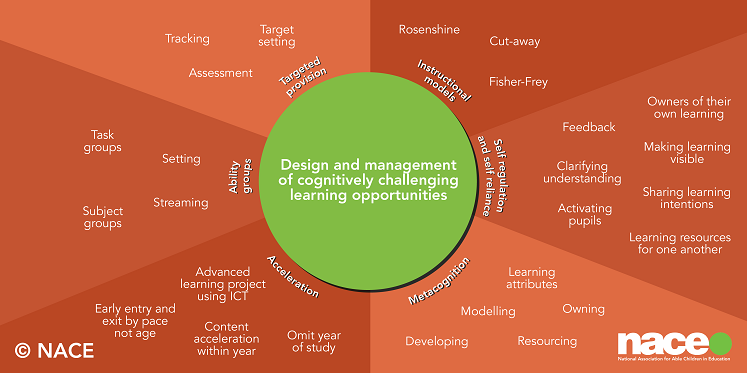
The organisation and management of cognitively challenging learning environments is one of three focus areas highlighted in NACE’s new research publication, “Cognitive challenge: principles into practice”, which marks the first phase in our “Making Space for Able Learners” project. Developed in partnership with NACE Challenge Award-accredited schools, the research examines the impact of cognitive challenge in current school practice against a backdrop of relevant research.
As teachers, we aim to provide a cognitively challenging learning environment for our more able and exceptionally able pupils, which is beneficial to them. The organisational decisions surrounding this should therefore optimise opportunities for learning. Teachers and school leaders must not only consider content to be studied, but also the impact of classroom management decisions from the perspective of the learner. The NACE research showed that these classroom management and organisational decisions were one of three key factors impacting on cognitively challenging learning, alongside curriculum organisation and design and the use of rich and extended talk and cognitive discourse.
 One aspect of managing cognitively challenging learning environments is any choice relating to mixed ability teaching versus a variety of designs for selection and grouping by ability. Within the classroom the teacher also balances demands to provide opportunities for all, while simultaneously identifying the nature and opportunity for challenge.
Does ability grouping benefit learners?
There is a paucity of strong evidence that ability grouping is beneficial to academic outcomes for all. However, Parsons and Hallam (2014) did find that grouping can benefit more able pupils. This benefit is not necessarily associated with the act of setting, but with the quality of teaching provided for these groups. Pupils also have opportunities to work at a faster pace, but against this aspiration, Boaler et al. (2000) found pace incompatible with understanding for many pupils. Regardless of the choice made to group or not to group, there is a need to reflect on whether teaching is homogenous or designed to meet the needs of the pupils. Often the weakness is the assumption that grouping alone will drive the learning experience, without an understanding of the cognitive and emotional impact this has on the pupils themselves.
The Education Endowment Foundation (EEF) has examined the use of setting and streaming, which are usually related to attainment rather than ability, and has found that there is often a small negative impact for disadvantaged pupils and lower abilities. When designing learner groupings, it is important to be aware of the impact for all learners and create a beneficial model for all.
How should teachers and schools approach ability grouping?
First, decide what you hope to teach and what it is pupils have the potential to achieve, given enough learning opportunities. Remember, learning is not limited to reproducing planned content by rote, but instead its success lies within a growth of knowledge, its complexity, and its application. Pupils bring a wide range of prior learning, knowledge and experiences which they can share with each other and use to construct new schema. In a well-designed learning environment, pupils have the potential to develop their knowledge, skills and understanding beyond the delivered content. Young et al. (2014) demonstrate the importance of powerful knowledge which takes pupils beyond their own experiences. The development of metacognition and exposure to wider experience should therefore be included in decisions related to the organisation of groups and lesson planning.
Second, decide what environment will provide the best learning experience for the pupils.
- Is it best to present advanced curricula at an accelerated rate?
- Does teaching include multiple high-order thinking models and skills?
- Is learning pupil-centred?
- Are multiple modality enquiry methods in play?
- Will grouping take account of the complexity of ability and enhance its manifestation?
- Will pupils benefit from a wide range of perspectives?
- Will pupils utilise the learning experiences of others to reflect upon and refine their own learning?
The answers to these questions will help teachers to make decisions regarding the nature of grouping and classroom organisation. The choice of model should be one which most benefits the learner, one which is not driven by systemic organisational requirements, and one which recognises the impact of external factors on perceived ability.
Finally, what models are available and how can cognitive challenge be achieved within them?
- Mixed ability grouping has the benefit of exposing pupils to the wider knowledge, background, and experience of others. In these environments, problems with different layers of complexity and multiple learning routes are often used. The big question or cognitively challenging proposition often promotes the learning with supporting systems and prompts in place for those challenged by the learning.
- Cutaway models are an alternative to the simpler mixed ability model. In the cutaway approach, the teacher constantly assesses pupils’ learning and needs and directs their learning to maximise opportunities, growth, and development. Pupils join and leave the shared learning (“cutting away” as appropriate), based on prior learning and their response to the existing task. This model develops and utilises independence and metacognition.
- Grouping by task is often used when it is possible to create smaller groups working on different tasks within the same classroom. The teacher uses very specific knowledge relating to pupils’ prior learning and abilities to organise the classroom groups. The teacher can therefore target the teaching to respond to more specific learning opportunities, which in turn can increase pupils’ enjoyment and engagement in their learning.
- Grouping by subject is an extension of grouping by task. If pupils learn all their subjects within the same class group, this enables the teacher to note the different strengths within the subject. In larger schools, pupils are often grouped by overall performance in specific subjects. This model might include advanced curriculum and require higher-order thinking skills. Pupils might be given opportunities to research more deeply into areas of interest. For this model to be successful there needs to be fluidity between the groups so that pupils are well-placed to enjoy cognitively challenging experiences.
With these ideas in mind, schools will then create an overarching model which reflects the school vision, ethos and culture. Teachers will consistently strive to provide cognitively challenging learning opportunities which benefit all. They use their knowledge of the pupils’ past and present learning and their vision of what the pupils can be and can achieve in the future to design the learning environment. They then organise the classroom to excite, engage and challenge their pupils – remembering that regardless of the sophistication of the approach, every group will be mixed ability as no two pupils are identical. If high-quality and engaging teaching is child-centred and not homogenous, then pupils will excel in cognitively challenging classrooms.
References
- Boaler, J., Wiliam, D. and Brown, M. (2000). Students’ experiences of ability grouping – disaffection, polarisation and the construction of failure. British Education Research Journal, 26 (5), 631–648.
- Education Endowment Foundation, Teaching and Learning Toolkit
- Parsons, S. and Hallam, S. (2014). The impact of streaming on attainment at age seven: evidence from the Millennium Cohort Study. The Oxford Review of Education, 40 (5), 567-589.
- VanTassel-Baska, J. and Brown, E. (2007) Toward Best Practice: An analysis of the efficacy of curriculum models in gifted education. Gifted Child Quarterly, 52, 342.
- Young, M and Muller, J. (2013). On the Powers of Powerful Knowledge. Review of Education1(3) 229-250.
Additional reading and support
Share your views
How do you use ability grouping, and why? Share your experiences by commenting on this blog post or by contacting communications@nace.co.uk
Tags:
cognitive challenge
CPD
differentiation
grouping
leadership
pedagogy
research
Permalink
| Comments (0)
|
|
|
Posted By Ann McCarthy,
17 November 2020
|
Dr Ann McCarthy, NACE Associate and co-author of NACE’s new publication “Cognitive challenge: principles into practice”.
When you’re planning a lesson, are your first thoughts about content, resources and activities, or do you begin by thinking about learning and cognitive challenge? How often do you consider lessons from the viewpoint of your more able pupils? Highly able pupils often seek out cognitively challenging work and can become distressed or disengaged if they are set tasks which are constantly too easy.
NACE’s new research publication, “ Cognitive challenge: principles into practice”, marks the first phase in our “Making Space for Able Learners” project. Developed in partnership with NACE Challenge Award-accredited schools, the research examines the impact of cognitive challenge in current school practice against a backdrop of relevant research. What do we mean by ‘cognitive challenge’?
Cognitive challenge can be summarised as an approach to curriculum and pedagogy which focuses on optimising the engagement, learning and achievement of highly able children. The term is used by NACE to describe how learners become able to understand and form complex and abstract ideas and solve problems. Cognitive challenge prompts and stimulates extended and strategic thinking, as well as analytical and evaluative processes.
To provide highly able pupils with the degree of challenge that will allow them to flourish, we need to build our planning and practice on a solid foundation.
This involves understanding both the nature of our pupils as learners and the learning opportunities we’re providing. When we use “challenge” as a routine, learning will be extended at specific times on specific topics – which has useful but limited benefit. However, by strategically building cognitive challenge into your teaching, pupils’ learning expertise, their appetite for learning and their wellbeing will all improve.
What does this look like in practice?
The research identified three core areas:
1. Design and management of cognitively challenging learning opportunities
In the most successful “cognitive challenge” schools, leaders have a clear vision and ambition for pupils, which explicitly reflects an understanding of teaching more able pupils in different contexts and the wider benefits of this for all pupils. This vision is implemented consistently across the school. All teachers engage with the culture and promote it in their own classrooms, involving pupils in their own learning. When you walk into any classroom in the school, pupils are working to the same model and expectation, with a shared understanding of what they need to do.
Pupils are able to take control of their learning and become more self-regulatory in their behaviours and increasingly autonomous in their learning. Through intentional and well-planned management of teaching and learning, children move from being recipients in the learning environment to effective learners who can call on the resources and challenges presented. They understand more about their own learning and develop their curiosity and creativity by extending and deepening their understanding and knowledge.
2. Rich and extended talk and cognitive discourse to support cognitive challenge
The importance of questions and questioning in effective learning is well understood, but the importance of depth and complexity of questioning is perhaps less so. When you plan purposeful, stimulating and probing questions, it gives pupils the freedom to develop their thought processes and challenge, engage and deepen their understanding. Initially the teacher may ask questions, but through modelling high-order questioning techniques, pupils in turn can ask questions which expose new ways of thinking.
This so-called “dialogic teaching” frames teaching and learning within the perspective of pupils and enhances learning by encouraging children to develop their thinking and use their understanding to support their learning. Initially, pupils might use the knowledge the teacher has given them, but when they’re shown how to use classroom discourse effectively, they’ll start to work alone, with others or with the teacher to extend their repertoire.
By using an enquiry-orientated approach, you can more actively engage children in the production of meaning and acquisition of new knowledge and your classroom will become a more interactive and language-rich learning domain where children can increase their fluency, retrieval and application of knowledge.
3. Curriculum organisation and design
How can you ensure your curriculum is organised to allow cognitive challenge for more able pupils? You need to consider:
- What is planned for the students
- What is delivered to the students
- What the students experience
Schools with a high-quality curriculum for cognitive challenge use agreed teaching approaches and a whole-school model for teaching and learning. Teachers expertly and consistently utilise key features relating to learning preferences, knowledge acquisition and memory.
Planning a curriculum for more able pupils means providing a clear direction for their learning journey. It’s necessary to think beyond individual subjects, assessment systems, pedagogy and extracurricular opportunities, and to look more deeply at the ways in which these link together for the benefit of your pupils. If teachers can understand and deliver this curriculum using their subject knowledge and pedagogical skills, and if your school can successfully make learning visible to pupils, you’ll be able to move from well-practised routines to highly successful and challenging learning experiences.
Taking it further…
If we’re going to move beyond the traditional monologic and didactic models of teaching, we need to recast the role of teacher as a facilitator of learning within a supportive learning environment. For more able pupils this can be taken a step further. If you can build cognitive challenge into your curriculum and the way you manage learning, and support this with a language-rich classroom, the entire nature of teaching and learning can change. Your highly able pupils will become increasingly autonomous and more self-reliant. They’ll become masters of their learning as they gain a deeper understanding of the subject matter. You can then extend your role even further, from learning facilitator to “learner activator”.
This blog post is based on an article originally written for and published by Teach Primary magazine – read the full version here.
Additional reading and support:
Tags:
cognitive challenge
creativity
critical thinking
curriculum
independent learning
metacognition
mindset
oracy
pedagogy
problem-solving
questioning
research
student voice
Permalink
| Comments (0)
|
|
|
Posted By The Bromfords School & Sixth Form College,
03 July 2020
|
Amy Clark, Assistant Headteacher for Quality of Education, explains how The Bromfords School and Sixth Form College has used Microsoft Teams to support both students and staff – delivering remote learning, pastoral support and peer-led CPD.
Being thrust into the world of remote learning has galvanised us to dig deep as a profession and do what we do best: find ways to make learning enjoyable – even in the toughest of times. At The Bromfords School, a small group of us had already been trialling the use of Microsoft Teams with our sixth form pupils to enhance the provision they were receiving, with the focus on enabling students to participate in a learning-rich environment without having to be in the classroom. Students loved having access to a digital learning space, outside of school, that they could use to have academic debates on key topics, share links to wider reading or resources and generally support each other in a collaborative way.
We also saw Teams as a way for staff to share best practice CPD. We all know what happens when you attend an amazing INSET day or twilight session; you eventually find time to do planning and create some wonderful resources that you share with colleagues, but they get lost amongst the mass of emails, meaning the brilliant work done often gets lost. The plan was to use Microsoft Teams to provide a specific space for professional dialogue about teaching and learning, where teachers could share resources, upskill each other and continue to develop as professionals.
Then along came COVID-19 and thrust our plans forward…
Using Teams for academic, pastoral and peer support
Even though the timeline for rolling out Microsoft Teams across the school was sped up, our staff certainly rose to the challenge. Whilst Teams isn’t the only software we have used to communicate remote learning to students, it is quickly becoming a space that students use for both academic and pastoral purposes.
Tutor group channels were set up on Teams for every year group, where tutors have been able to ‘check in’ each week with pupils. This has ensured that students’ academic needs are met, that students have access to advice should they need it, but most importantly, tutors could keep track of students’ mental wellbeing. Open lines of communication meant that if a child was struggling, we could support them. Students didn’t know how to work remotely, how to organise their time or how to be self-motivated; our use of Teams has provided them with methods for easy communication with an adult they are familiar with on a daily basis.
We hope that by having the lines of communication open to students and having a compulsory check-in each week, the bridge between students working in isolation at home and returning back into the building is eased and that that we are able to lower anxiety for our students.
Our Teams CPD channel has supported staff not only in developing their IT skills to enable the best possible provision for students, but also in accessing a range of ideas they might not have come across before. Our channel has ‘How to…’ videos on topics including the use of narrated PowerPoints, quizzes or forms on Teams, how to use ‘assignments’ within Teams and mark these using a rubric to give feedback on the work completed, to name just a few. Staff have also shared information on how to create drop-down and tick-boxes in Microsoft Word, where to go to get icons for dual coding, methods for increasing student engagement and other concepts that will improve remote learning.
Even staff members who are self-proclaimed ‘technophobes’ have been able to develop their IT skills to ensure the digital learning process for our pupils is as strong as it can be. The channel has enabled everyone to feel like we are all in this process together, all learning together – and nothing is as daunting when you have others by your side.
Five core principles for effective remote learning
As a school, we were keen to ensure we were catering to the needs of all our pupils during this time, with our more able students being a key focus. We wanted to ensure the provision offered to this group remained high quality so they were able to continue to be challenged academically – avoiding the dreaded generic worksheet, a one-size-fits-all approach. We also found that many of our more able were struggling with managing workload, which developed increased levels of anxiety.
A group of leaders and I developed what we felt were the five core principles of remote learning and delivered this to staff through CPD meetings, to ensure our more able students were academically and emotionally supported.
We felt that remote learning should be:
- Concrete: it should have a clear purpose and learning intent that fits with the wider curriculum. There should also be clear timings for tasks so that students do not spend excessive amounts of time on projects.
- Inclusive: consider how you stretch your most able students by providing links to wider reading, podcasts, challenge tasks or breadth of choice such as presentation methods.
- Considerate: taking into consideration students’ learning environments and access to materials they could need. Also planning tactically so that students do not become overwhelmed with the sheer amount of work expected of them.
- Reflective: students should have feedback at key points and self-assessment opportunities through sharing clearly defined success criteria.
- Engaging: staff should incorporate a range of learning activities and software to avoid students becoming demotivated. Also focusing on mechanisms for praise so that students know their hard work is being recognised.
The concepts here are not new. But when staff are also dealing with the pressures and anxiety a COVID-19 teaching world presents, it is a timely reminder that the core principles of teaching must remain so that students can continue to succeed. The five core principles listed above all aim not only to enrich the remote learning a student receives, but also take into consideration students’ mental wellbeing too.
When we return to school, I hope the lessons learnt from using technology during this time do not get lost. Many members of staff have told me how much they have enjoyed using Microsoft Teams to support learning and how they will continue to use it moving forward, particularly to aid collaborative work with peers and to support home learning. Our eyes have been opened to the potential of this technology in supporting and enriching the curriculum for more able students though many of the methods listed above. It has certainly provided both staff and students with a very different learning experience, with the potential to continue to enrich learning beyond the classroom for students and increase enjoyment in developing pedagogy for staff.
Read more:
Tags:
apps
collaboration
CPD
KS5
lockdown
pedagogy
remote learning
technology
wellbeing
Permalink
| Comments (0)
|
|
|
Posted By Matthew Williams,
21 May 2020
|
Dr Matthew Williams, Access Fellow at Jesus College, Oxford, shares his belief in the importance of “confident creativity” as the key to developing sustained effort and a lasting love of learning.
I am a fellow and tutor in politics at Jesus College, Oxford, and I’d like to share some thoughts on how students can be energised to “work harder”. Specifically how do we encourage sustained effort, leading to improved attainment? What follows are reflections on a decade of teaching and schools outreach work at Oxford and Reading Universities. There is a mixture of theory here, but readers should be warned there will also be big dollops of unscientifically personal recall.
As an undergraduate student of politics at the University of Bristol, the most significant learning experience came during seminars on the British Labour Party. At first, I was fairly indifferent on the subject, but the seminars entailed a mixture of traditional essay-based research and more flashy simulation-based learning. On the latter, we had a Cabinet meeting in our seminar with each of us playing real characters. I was Jim Callaghan, and I had to prepare Cabinet papers, work out strategy and tactics in order to win a fight with, in particular, Tony Benn!
The experience brought everything to life. The theoretical and practical came together, and I have to this day never forgotten the specifics of that fight in late 1976. On reflection, the primary effect of the simulation was the transformation of the subject matter from work into study. Studying is not work in the sense of being performed for someone or something else’s benefit. Instead, studying is intrinsically pleasurable. Whilst many students are motivated by long-term payoff (career prospects, reputation, power etc) many, like me, see more immediate feedback. This particular teaching style transformed the 9am walk to lectures from a reluctant trudge to an enthusiastic commute. It was revelatory.
Demystifying the means of achieving distinction
Ever since those seminars I have aspired in my personal and professional life to transform work into study. The key ingredient used by the seminar tutor was positive motivation. He made clear his interest was in us and our ideas, rather than our performance in the exam and the reputation of the university. As such, he did not want us to regurgitate the literature, rather he wanted us to know the literature so we could analyse it critically whilst presenting our own original contributions.
This was liberating. All of sudden the most complex elements of social democratic ideology and post-industrial economics were not prohibitively intimidating; they were required reading for anyone wishing to have their voice heard. In this process, we had to acknowledge we could contribute to a debate despite our relative academic inexperience. The tutor was clear: good ideas are not the monopoly of tenured professors. If we wanted to, we were perfectly capable of contributing original theoretical insights and empirical discoveries. To achieve the distinction of a first class degree our work had to be creative and, crucially, the tutor made clear we were all capable of distinction if we wanted it.
This teaching style resonated with me because it demystified the means of achieving distinction. Previously, I had assumed distinction was a matter of talent, intelligence and luck – none of which I felt much graced with. Subsequently, I realised distinction meant creativity, and creativity needed energy and self-confidence.
Understanding the importance of “confident creativity”
“Confident creativity” is not my first teaching philosophy. For a job application in 2012 I proposed a similar philosophy focused on positive motivation and confident application of skills. Whilst this is seemingly the same philosophy, the older version was predicated on teaching as the transmission of knowledge, where now I see teaching more as developing and nurturing key skills. The transmission model prioritised interesting learning materials as the fundamental variable; whilst I still consider the materials to be important, they are secondary to the students’ nurtured development of complex skills. When students internalise the skills of processing complex information, they will find interest in practically all relevant materials, without the need for unrepresentatively “sexy” content. Even a 1970s Cabinet meeting can become enthralling!
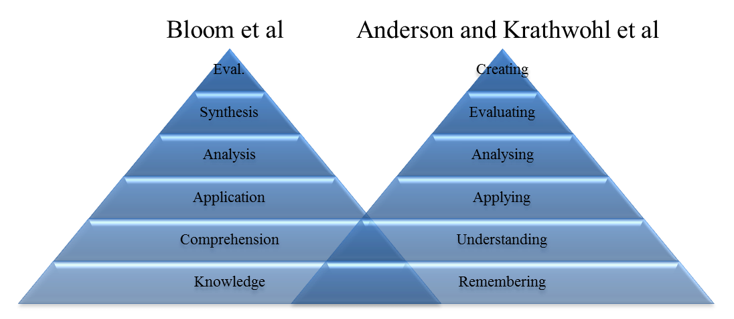
The key change in my teaching philosophy has been the realisation that motivating students should encourage a sense of independent intellectual development. This change in emphasis can be represented as a synthesis of two learning outcome hierarchies, proposed by Bloom et al (left pyramid) and Anderson & Krathwohl et al (right pyramid).
I propose a synthesis of these taxonomies, fleshed out with qualifying adjectives:
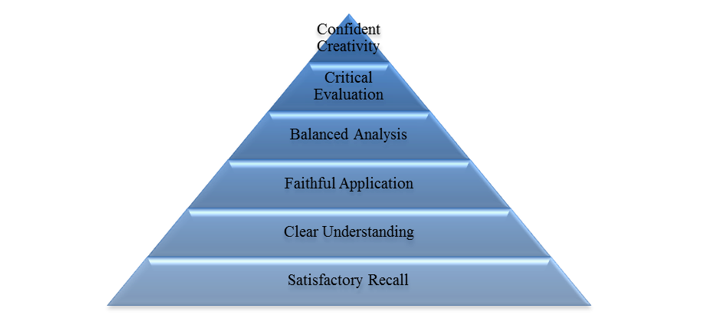
Including qualifying adjectives in Anderson & Krathwohl et al’s hierarchy allows us to assess the learning objectives in greater detail, with clearer observable implications. Adding an extra level of nuance to the concepts enriches their meaning, without losing the parsimony and clarity which are such key strengths of the original taxonomy. The addition of adjectives could be criticised as creating needless tautologies – if, for instance, we assume confidence is a necessary condition of creativity. However, creativity can be achieved without confidence if it is accidental and the student is unaware of the merits of their creativity. We need to aim for confident creativity because it is significantly more sustainable and transferable for a student to create in confidence than to be creative by accident or with heavy-handed guidance.
Transferring this approach to different contexts
Critical reflexivity is a very personal journey, and the results of my personal reflections may not be transferable. Even the phrase “teaching philosophy” connotes a sense of philosophy as retroactive rationalisation of one’s own perspective, as opposed to the analytic use of the term as a clear, open and rigorous system of thought. As Nancy Chism states, somewhat ironically, “One of the hallmarks of a philosophy of teaching statement is its individuality.” Whilst a teaching philosophy is developed through self-reflection, it requires self-awareness before it can be applied to others. Notably, teachers are somewhat unusual in their relationship with knowledge. They relish the acquisition of knowledge as an intrinsic good, where motivation to learn is rarely absent and the desire to contribute is second nature.
But what is good for the goose is not necessarily good for the gander. For many students school and college is first and foremost about acquiring qualifications, and therefore simply an instrument for career advancement. As such, not all students want to achieve distinction, nor see the value in risking creative contributions when a less resistant path exists. For such students there is a risk that emphasis on creativity will alienate them from the subject and the teacher. Furthermore, the development of my teaching philosophy has primarily taken place at an elite university, where boundary-pushing and intellectual confidence is far less risk-laden than in other contexts. The unflinchingly liberal environment at Oxford ascribes considerable value to intellectual creativity, perhaps at the expense of consolidation. Yet there is little utility in a teaching philosophy that is contingent on where and for whom it applies.
Nevertheless, these concerns are surmountable. Yes, academics perhaps have a gilded view of knowledge, but only because they have internalised the skills of contributing knowledge to the point where it has become (for the most part) a pleasure. It is incumbent on academics to encourage students towards a similar relationship with the world. Whilst not all students will want or feel able to contribute genuine insights, “confident creativity” is the apex of the pyramid and there are other levels of learning available to differentiate between learners. The ambition should be to encourage confident creativity, but “critical evaluation” or “balanced analysis” will be satisfactory outcomes for many students. Learners should not be forced to fit a teaching style that alienates them and a degree of differentiation between students will be required with the proviso that “confident creativity” is unambiguously the preferred goal and should be encouraged as far as possible.
Ultimately, the point of education is to equip individuals with the skills to speak for themselves. This is best achieved when we mix up teaching styles, and jolt work into study.
References
- Anderson, L.W., Krathwohl, D.R., Airasian, P.W., Cruikshank, K.A., Mayer, R.E., Pintrich, P.R., Raths, J., & Wittrock, M.C. (eds) (2001) A Taxonomy for Learning, Teaching, and Assessing. (New York: Addison Wesley Longman Inc).
- Bloom, B.S., Engelhart, M.D., Furst, E.J., Hill, W.H., & Krathwohl, D.R. (eds) (1956) Taxonomy of Educational Objectives: The Classification of Educational Goals – Handbook 1: Cognitive Domain. (London, WI: Longmans, Green & Co Ltd).
- Chism, N. V. N. (1998) “Developing a Philosophy of Teaching Statement.” in Essays on Teaching Excellence 9(3) (Athens GA: Professional and Organizational Development Network in Higher Education).
- Pratt, D.D., & Collins, J.B. (2000) ‘The teaching perspectives inventory: Developing and testing an instrument to assess teaching perspectives’ Proceeding of the 41st Adult Education Research Conference.
About the author
Dr Matthew Williams is Access Fellow at Jesus College, University of Oxford, where he teaches and conducts research in the field of political studies. Known as “the Welsh College”, Jesus College has a long history of working with schools in Wales and has recently taken on responsibility for delivering the university’s outreach and access programmes across all regions of Wales. Read more.
Live webinar: “Developing sustained effort in able learners”
On 2 July Dr Williams is leading a free webinar for NACE members in Wales, exploring approaches to developing confident creativity and motivating learners to be ambitious for themselves. This is part of our current series supporting curriculum development in Wales. Find out more and book your place.
Tags:
aspirations
confidence
CPD
creativity
independent learning
Oxbridge
Oxford
pedagogy
Wales
Permalink
| Comments (0)
|
|
|
Posted By Bill Lucas,
10 July 2019
|
Professor Bill Lucas, Director of the Centre for Real-World Learning at the University of Winchester, shares five key steps for schools and practitioners seeking to embed creativity in teaching and learning.
It’s 20 years since the landmark National Advisory Committee on Creative and Cultural Education report All Our Futures: Creativity, Culture and Education was published. The report offered a simple definition of creativity: “Imaginative activity fashioned so as to produce outcomes that are both original and of value.” Two decades on and we are much clearer about the cultural and pedagogical changes necessary for creativity to be embedded in schools, so much so that PISA has made creative thinking the subject of a new test in 2021.
Closer to home, Wales is launching a new curriculum that gives a central place to creativity and the new Ofsted framework comes into force this year. Not traditionally associated with creativity, Ofsted’s encouragement to schools to think more widely about curriculum and to document their intent, implementation and impact is an opportunity to rethink the role of creativity in schools.
In this context, here are five key steps to consider:
1. Understand what creativity is
You might like to start by familiarising yourself with our model of creativity and its five habits:

Bill Lucas, Guy Claxton and Ellen Spencer, ( OECD, 2013) 2. Review your classroom culture
Look at these 10 statements and ask yourself how much your classroom encourages these:
- Learning is almost always framed by engaging questions which have no one right answer.
- There is space for activities that are curious, authentic, extended in length, sometimes beyond school, collaborative and reflective.
- There is opportunity for play and experimentation.
- There is opportunity for generative thought, where ideas are greeted openly.
- There is opportunity for critical reflection in a supportive environment.
- There is respect for difference and the creativity of others.
- Creative processes are visible and valued.
- Students are actively engaged, as co-designers.
- A range of assessment practices are integrated within teaching.
- Space is left for the unexpected.
10 of 10? Go to the top of the class! 5 out of 10? Encouraging. Just 2 or 3 out of 10? You’re out of the starting blocks but have a way to go yet…
3. Use signature pedagogies to embed creativity
A signature pedagogy is a teaching method which is explicitly connected to the desired outcome of any lesson. So if you want curious students you might choose problem-based learning. If you want pupils to be critically reflective, then philosophy for children might be a helpful approach. Or if persistence was your goal, then any number of growth mindset type approaches such as changing learner talk from “can’t” to “can’t yet” might work. Other useful methods include the use of case studies, deep questioning, authentic tasks, a focus on the design process, enquiry-led teaching and deliberate practice.
4. Use split screen teaching to embed creativity in every subject
Split screen teaching, pioneered by my colleague Guy Claxton, invites teachers to describe two worlds, the disciplinary subject matter of their lesson and the aspect of creativity on which they are also focusing. Let’s say you were introducing a science activity to understand the properties of acids and bases and then pupils were to prepare a short demonstration for other pupils, who would in turn offer feedback to their peers on the effectiveness of their explanations. Or in a history lesson, students might be looking at the causes of the First World War at the same time as they are exploring aspects of critical thinking such as the use of primary sources of evidence.
In the imaginary split screen of the lesson and its objectives a teacher would take care to explain to the class that both the chemistry (acids and bases) and the creative thinking (giving and receiving feedback) objectives were equally important.
Split screen teaching reminds us of the importance of embedding creative habits in the context of a subject. For example: history + critical reflection; scientific enquiry + appropriate cooperation; writing an argument in English + challenging assumptions.
5. Use thinking routines
The use of visible thinking routines, well-documented by Harvard University’s Project Zero, is an invaluable way of moving from knowledge to creative habits. A routine such as Think-Puzzle-Explore embeds inquisitiveness, while Think-Pair-Share-Think provides routine opportunities for challenging assumptions and giving and receiving feedback.
Later this year the Durham Commission will make recommendations for ways in which school leaders and teachers can be supported in England. Now is the time to get determined and creative about giving all children the chance to develop their creativity at school.
Professor Bill Lucas is director of the Centre for Real-World Learning at the University of Winchester and co-chair of the strategic advisory group for the Programme for International Student Assessment (PISA)'s 2021 test of creative thinking. He is the author of many books on creativity and learning including, with Ellen Spencer, Teaching Creative Thinking: Developing learners who generate ideas and can think critically. He tweets at @LucasLearn
Tags:
creativity
curriculum
pedagogy
PISA
research
Permalink
| Comments (0)
|
|
|
Posted By Laura Bridgestock,
13 March 2019
Updated: 03 June 2019
|
Schools that successfully develop and maintain a broad, challenging and opportunity-rich curricular and extracurricular offer recognise the benefits this brings for all learners – not just those designated “more able”. The examples of such successful schools reflect NACE’s own focus on provision for more able learners as part of a much broader context of challenge for all and whole-school improvement. The NACE Challenge Development Programme offers a framework and support to help schools review and improve more able provision, driving improvements in provision and outcomes for all.
In this context, and amidst lively national debate about the purpose and content of the curriculum – including questions raised by and impacting on proposed changes to the Ofsted inspection framework – this year’s NACE National Conference will explore the theme: “How to lead a curriculum of opportunity and challenge: provision for more able learners that supports high achievement for all”. The event will draw on NACE’s own research and work in this field, alongside examples of effective practice from NACE Leading Schools and insights from experts in pedagogy, curriculum, and school review and improvement. Ahead of the day’s discussions, we’ve picked out five key factors to consider – drawing on the work of educationalist and author Martin Robinson, who will deliver the conference’s opening keynote.
1. Get clear on the terminology
Much of the terminology currently used in discussions about the curriculum is, when probed, somewhat vague. As Robinson points out, few would object to epithets such as “ knowledge-rich” or the ubiquitous “ broad and balanced” – but on further investigation such terms raise many more questions than they address, particularly when it comes to implementation on the ground. For discussions to progress meaningfully, clarity is important.
2. Involve everyone in curriculum design
The curriculum needs to work for everyone in school – and that means staff as well as learners. Curriculum coherence – an overriding structure that can be perceived and understood by all, with each teacher and learner understanding their current position and next steps – will remain a pipe dream if not built on genuine opportunities for collaborative curriculum design, delivery and review. This collaborative approach should be extended not only to staff members, but also – as NACE trustee Liz Allen CBE argues – to learners.
3. Put pedagogy in the picture
While no longer the buzzword du jour, pedagogy remains an essential concern and – as Robinson argues – should be considered at all stages of curriculum design. Sequencing (more on this below) is but one aspect of a repertoire of approaches which will lead to deep and sustained learning. Of these NACE frequently highlights:
- Content and related skills and concepts pitched at the right level of difficulty and complexity;
- Skilful and judicious explanation, modelling and feedback;
- Opportunities for deliberate practice;
- The development of metacognition and independence in learning;
- Tasks and activities designed to elicit higher-order and critical thinking processes;
- The management of differentiation which keeps all routes open for learners to achieve and progress.
Alongside these approaches, one of the biggest impacts on learner outcomes and engagement is what is often referred to as a positive and demanding classroom climate, coupled with teachers’ high expectations of all learners.
4. Get the timing right
Alongside the “what” and “how” of the curriculum, the “when” is also important. While “blocking” can seem the most efficient way to cover all the required content within the time available, Robinson makes the case for “spacing” – building in deliberate periods of delay in the coverage of a topic, to improve retention rates and curb last-minute cramming come exam time. This approach can be envisaged as a “spiral curriculum” – in which teaching and learning spiral back to revisit and build upon the “basic ideas” at the core of a subject, supporting overall coherence, joined-upness and progression.
5. Join the national debate
This is an exciting time for school leaders and educators – not without its challenges, but also rich in opportunity. Amidst a growing body of research on what works for more able and for all learners, including the impact of pedagogical approaches such as “teaching to the top”, we’ve seen a renaissance of evidence-rich debates about curriculum development and delivery. At its best, the debate has gone beyond old dichotomies, producing fresh approaches and working towards secure foundations and principles on which to build a curriculum fit for today and for the future.
Join us at the NACE National Conference in London on 20 June to be part of the debate!
Tags:
CPD
curriculum
pedagogy
Permalink
| Comments (0)
|
|
|
Posted By Ben Weddell, National Maritime Museum,
03 January 2018
Updated: 08 April 2019
|
The National Maritime Museum recently hosted a NACE member meetup exploring approaches to working in depth for the more able. Following on from the event, the museum’s Ben Weddell explains how an enquiry-based approach to history can be used to inspire and challenge learners of all ages and abilities.
Recently the National Maritime Museum (NMM) learning team were lucky enough to host a NACE member meetup. Following a presentation on SOLO Taxonomy and a “speed sharing” session, we had the opportunity to share the museum’s approach to teaching historical enquiry and how this can translate to the classroom, based on my experiences at the NMM and as a secondary history teacher.
History as an investigative process
A fascinating aspect of learning about the past is the realisation that we have to discover it. Far from a list of dates and occurrences to be memorised and regurgitated, history can – should – be an investigative subject of discovery.
This is a far more interesting and engaging approach, and one which provides opportunities to personalise and differentiate, by giving learners agency for the routes they take in uncovering the past.
Indeed, for history to have any meaning as a subject I would argue that it has to be investigative. It is through the skills which constitute a historical methodology that “history” comes to make sense as a coherent single subject.
Defining a historical method
If challenged about the scientific method, most teachers would be able to outline the “hypothesis, experimentation, new hypothesis” model. Is it possible to repeat that for history? If there is a scientific method that learners can grasp, surely there has to be an equivalent for history.
Historical enquiry is the skill that fills this gap. This starts from the premise that we don’t know what happened in the past and have to discover this for ourselves – a great learning opportunity as this is where learners themselves begin. Rather than treating learners as passive vessels to be topped up with historical information, this approach challenges them to uncover the past themselves.
Furthermore, there is an expectation in the national curriculum that enquiry will be taught:
“Pupils are expected to understand the methods of historical enquiry, including how evidence is used rigorously to make historical claims, and discern how and why contrasting arguments and interpretations of the past have been constructed.”
This process builds from KS1 to KS2 and 3, developing skills in dealing with isolated blocks of evidence and then establishing links between these, culminating in the ability to assess, ask questions of, and reflect on a large bank of potentially contradictory evidence and come to sound conclusions.
Harnessing the power of objects
One way to engage learners in this journey is to incorporate object-based enquiry. History teaching often focuses around the spoken and written word, resulting in a teacher-led approach. Using objects, especially in a multisensory capacity, can add interesting new dimensions to learning:
Increased motivation and curiosity
- Accessibility, through the ability for learners to raise their own questions
- Multisensory approaches providing different access points for a range of learners
- “Realness” – aiding understanding of abstract ideas through a focus on tangible objects
- Cross-curricular opportunities for literacy, incorporation of other forms of evidence and other subject areas
It is possible to build enquiry opportunities using a huge range of objects, so developing a specific object bank is useful but not essential. Whether making use of printed resources or actual physical objects, the process of conducting an enquiry is what brings the object to life.
Let learners find their own challenge
Larger enquiries offer extensive opportunities for teachers. The key is to provide a limited amount of initial evidence and then allow learners to formulate their own responses. This creates effective differentiation and provides unique opportunities for learners to create their own working level, including the more able.
Furthermore, a creative introduction to the initial information – say roleplaying an archaeological discovery or a new finding in a document or database – provides motivation for learners to set themselves a challenging question.
It is then possible to expand investigations with the introduction of new evidence. There is flexibility in the range and scope of evidence you introduce, which will be determined by learners’ needs and level. For instance, a limited suitcase of objects could be investigated by KS1 learners, whereas by KS3 a teacher could overload learners with objects, so they have to differentiate between useful evidence and red herrings or irrelevant information.
In practice this could take the form of:
- One-off mysteries (KS1/KS2): a collection of objects to consider and a simple guided outcome, for instance “Whose suitcase might this be?”
- Developed enquiries (KS2/KS3): building on initial discoveries to develop an entire scheme of work, for instance “Why was this object found in the Arctic?”, leading into a wider investigation of John Franklin’s doomed final voyage to the Arctic, linking more widely to Arctic exploration.
- Self-led enquiries (KS3): initial collection of evidence and a problem, leading to a project including opportunities for learners to define their own questions and route, selecting appropriate evidence from a wide range and engaging with controversies.
All of these models follow the same process – starting with initial evidence, developing a hypothesis, testing with additional evidence, then repeating with a new hypothesis and so on. The cyclical nature of this process is marked by increasing degrees of certainty in learners’ findings as they increase the depth and range of the evidence they have based their ideas upon.
Enquiry as part of a wider pedagogy
Making enquiry a central part of learning has a number of benefits. It revolves around approaching topics with a focus on teaching skills that can then be used to access content, as opposed to a discrete delivery of content and skills. In turn, this means that history begins to make coherent sense, challenging some learners’ misconception that it is “just stuff that has happened”.
The skills acquired will also be more easily transferable and encourage a cross-curricular approach. Significantly, these skills are highly applicable to a wider world in which the ability to assess and sift incoming information is becoming ever more crucial.
Historical enquiry fits well with other pedagogies, such as SOLO Taxonomy or other progressive models such as Bloom’s. As the enquiry progresses, individual learners move through different stages of thinking skills, with initial stages of identification and definition, progressing to description of evidence, classification and analysis, through to evaluation and hypothesising around a wide range of evidence.
This approach forms the basis for historical enquiry sessions at the National Maritime Museum. These sessions include KS1 investigations into where breakfast comes from, full-day secondary study sessions incorporating original archive materials, and expert research sessions for post-16 students. You can find out more about these sessions on our website or through our guide to school programmes, which can be found here.
Useful links:
- National Maritime Museum for schools – including information about school visits, CPD opportunities, downloadable resources and more.
- Royal Museums Greenwich collections – searchable database of the Royal Musuems Greenwich collections, ranging from maps and charts to a taxidermy penguin! Includes images and information which can easily be adapted as resources for teaching and learning.
- Spartacus Educational – free-to-use site hosting historical resources and materials, useful for creating banks of evidence to build an enquiry.
- Thinking History – website of Ian Dawson, one of the founders of the Schools History Project, with a huge array of fantastic enquiry-based sessions available for free.
Ben is a learning producer at the National Maritime Museum, Greenwich, where he specialises in historical enquiry programmes for learners of all ages. He previously worked as a history teacher in secondary schools and a sixth form college, with a particular interest in opportunities to build historical enquiry into the curriculum. To find out more about Ben’s work and how your school could get involved, contact NACE and we will put you in touch.
Tags:
enquiry
free resources
history
pedagogy
Permalink
| Comments (0)
|
|

 Blog Home
 All Blogs
 Print Page
 RSS
RSS